Florence Nightingale tending the sick and wounded during the Crimean War. Lithograph E. Walker; Day & Son. Located in the Library of Congress. Copyright expired.
By A. G. Moore
It is ironic that throughout history, war has been an effective laboratory for creating advances in medicine. Human beings are the raw material of war. Injured humans, sick humans, cannot carry out the mission of their masters. They cannot win victories if they perish from wounds, or struggle with illness. It is in the interest of nations and the leaders of nations to protect soldiers. And thus, history shows, war has been the environment in which medical innovation and discovery has often occurred.
Of course, there have been idealists who labored, in war and peace, to improve medical care. No slight is here intended to these heroes. I am in awe of often unacknowledged and anonymous benefactors who give their lives to save the lives of others. But even in these instances, it has often been the case that the work of the idealist is sponsored and supported by a less altruistic actor.
For example, Florence Nightingale traveled to the Crimea in the midst of a terrible war because she wanted to save lives. No one has ever been able to impugn the motives of this great nurse and medical innovator. Her actions saved not only British soldiers but countless soldiers of all nationalities who fought in successive wars.
As is typical of medical innovation prompted by warfare, Florence Nightingale’s insight and reforms also extended to civilian populations. She began a revolution in sanitation and nursing that has benefited every generation, civilian and military, across the world.
Not only did Florence Nightingale improve nursing and hospital practices, she also inspired a transformation in battlefield ethics. Because of her example and advice, the concept of neutrality for professional medical personnel evolved as a modern concept in warfare. The Geneva Conventions, which cemented this concept in international law, were a legacy of Florence Nightingale’s influence.
However, without the Crimean War, and without the English Crown’s need for healthy soldiers to carry on in battle, Florence Nightingale might never have gone to the Crimea. The English Crown was in crisis because of the appalling number of deaths suffered by its soldiers in the Crimea. This crisis threatened to deny the English a victory in the Crimean War.
Florence Nightingale became an angel to suffering soldiers in the Crimea and a savior to the English war effort. She became a popular figure to families in Britain whose loved ones were saved and she became a national hero because of her contribution to the war effort. Queen Victoria personally awarded Florence a unique medal, The Nightingale Jewel, in commemoration of her extraordinary service.
Medical innovation in wartime did not not begin or end with Florence Nightingale. In the ancient world, Greek, Egyptian and Indian doctors traveled to battlefields to treat the wounded. Improved surgical techniques were the result.
In more modern times, Jonas Salk worked on an influenza vaccine at the behest of the US government during WWII. It was the successful development of a flu vaccine that helped Salk to understand the direction to take in his research on a polio vaccine.
The carnage of war throughout history has been a prompt for development of therapeutic medicine. This is an opportunistic result: the attention and energies of great powers focus on medical care at these critical junctures because of battlefield imperatives. A true advance would be for state leaders to see the urgency of focusing on medical care in peacetime, when the needs of civilian populations are front and center. This would represent not only a revolution in medical science but also a essential evolution in the human condition.
Try to see the blank page as an opportunity and not a challenge.
By A. G. Moore
You’re probably reading this essay because you want to improve your writing skills. That is the first and most important step on the path to good writing. The next step is easier. Pick up your instrument of choice–a pen, a pencil, a keyboard–and start writing.
Writing is like speaking. At first, when you begin–whether it’s a foreign language or your native language in the early years of life–speaking requires great effort. You struggle for the correct phrase. You stumble and make mistakes. After a while, as you practice and use language on a daily basis, your speech becomes smoother. You think less about how you say something and more about what you want to say. This is fluency.
Fluency is the goal in writing and is achieved in exactly the same way that it is accomplished in speech: practice. The more frequently you write, the more fluent your writing becomes. Once fluency is achieved, certain techniques and rules will help to make the writing more effective. These rules and techniques are easily mastered, but they won’t work unless you have something to use them on. So write–anything. Write what you’d like to say. Worry about correctness later.
Organization, grammar, style–these will come with time. Think of the pieces you write as blocks of clay. Each time you start out there is no shape, no form to the clay. As you begin to mold you have an idea of what you would like to see at the end of your sculpting. After the first cuts, the lump of clay won’t look like anything. After a while, as you shape a crude form, you can go back with your chisel and refine your art.
That’s exactly what happens in most writing.
Of course, there are exceptions. There are brilliant masters who have a touch of genius. Words pour from them as water does from a fountain. Most of us don’t have that gift. Most of us will settle for communicating effectively. If that is your goal, then form an idea, sit in front of a blank page and begin to express your idea. Once you have words on a page, once you have the rough clay crudely formed, you can use basic techniques to fashion a finished product. Logic, grammar, style–these are just carefully targeted cuts in the clay. They can be added and adjusted as the piece takes shape.
The more often you engage in the process of writing, the more fluent you will become. If you doubt this, think about the way you learned to speak. You’ll realize that the separation between the spoken word and the written word is merely a matter of perspective and familiarity. Both of these are in your control and really present no barrier at all.
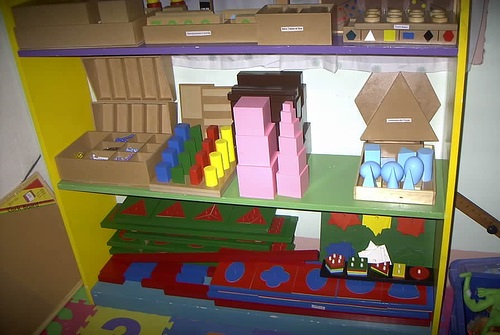
These are learning materials designed specifically for a Montessori classroom. Author Attribution:mr suave 2007/Ross Joan On Wikimedia Commons Used under the Creative Commons Attribution 2.0 Generic license.
By A. G. Moore
Dialogue on Education #3 Maria Montessori: Nominated for the Nobel Peace Prize; Awarded the French Legion of Honor
Maria Montessori’s ideas about education had much in common with those of both Rabindranath Tagore and Marie Curie. While all three began with the idea that children learn best when responding to their environment, Curie and Tagore envisioned a more freely structured experience than Montessori did.
Tagore and Montessori met in 1939. Before that they had corresponded and shared ideas. Each recognized that they shared a philosophical sympathy. Both believed that education should be child-centered but that the environment in which that education occurs should be stimulating and rich. The difference between the two philosophies may be rooted in Montessori’s fixed ideas about child development. She believed that children go through distinct stages of learning in which they are receptive to distinct kinds of growth.
Montessori designed specific materials and described particular environments that are suitable for children in the different stages of development. While it is true that children in a Montessori system are allowed to respond to their environment in an organic way, the environment they are offered is very structured.
The Montessori system offers children freedom, but freedom within limits. Classrooms are “learning triangles.” The three points in the triangle are the teacher, the materials and the student. When the student responds to appropriate materials and the teacher guides that response, Montessori believed, an optimal environment for learning and development exists.
As discussed in Dialogue #1 on this page, Marie Curie devised a system of education for her children in which they rotated from one rich environment to the other through the days of the week. The children were allowed to dabble in those areas that caught their interest. Curie believed that learning, in the right environment, would occur naturally and effortlessly. She believed knowledge acquired in this way would have a firmer and more enduring hold on a child’s intellect.
In Dialogue #3, Tagore’s informal approach to education is discussed. He placed his students in a stimulating environment with art, music and nature having principle influences. Tagore did not structure his program with age-appropriate modalities. He expected children’s interest to expand with the richness of their exposures.
While Tagore, Montessori and Curie differed in the way they created learning environments for children, all three shared one over-arching principle: the child leads the way. The child is offered the opportunity to learn and if that opportunity is attractive enough the child will thrive.
Dialogue on Education #2: Rabindranath Tagore, Nobel Laureate in Literature
The first entry on this page described Nobel Laureate Marie Curie’s attitude toward formal education. The second dialogue discusses the views of another Nobel Laureate, Rabindranath Tagore.
Rabindranath Tagore with Mahatma Gandhi in Santiniketan, the site of Tagore’s school and university. Taken before 1942, public domain.
Rabindranath Tagore was a philosopher, artist, poet, playwright, musician and social reformer. In 1913, he became the first non-European to be awarded the Nobel Prize in Literature. Despite this distinction, Tagore never earned a formal academic degree. When referring to his own education, Tagore spoke about ‘freedom’, not ‘discipline’. He described his childhood home, which inspired his point of view, as one in which “freedom in the power of our language, freedom of imagination in our literature.. ” prevailed. Rote learning and routinized instruction were stifling and counterproductive, in his view.
Tagore believed that education was an organic process in which the individual responded to the environment. Much in his philosophy of education resembled that of another Nobel Laureate, Marie Curie. Both Nobel Prize winners placed strong emphasis on nature. Both insisted on the importance of physical exercise. And both believed that exposure to brilliant minds and brilliant work would elevate, not frustrate, a child. Both were certain that bombarding a child with structured lessons was more likely to kill an appetite for learning than to stimulate it. They believed that acquiring knowledge should be as effortless as acquiring language is for a toddler.
While Rabindranath Tagore and Marie Curie believed that children should live in a harmonious relationship with nature, Tagore carried the theme of harmony further. He believed it was a function of education to foster harmony between people. He wanted children to be taught arts, especially music, because he thought that would enable them to develop sympathy for others. He thought that education should emphasize the progress of nations and not focus on wars and territorial conquests.
Rabindranath Tagore did not simply aspire to educational ideals: he gave them life. In 1901 he founded a school, Patha Bhavana, which embodied his principles. After he won the Nobel Prize, he invested in his school and expanded it into a university. That campus is now the site of one of the most prestigious universities in India, Visva-Bharati.
Were Rabindranath Tagore’s ideas about education misguided? Many people who work in education today apparently believe so. Increased emphasis on standardized learning and objective testing seems to be proof of that. Schools today are laboratories in which competing theories of education are tested. As the experiment with today’s children procedes, so will the dialogue about their future continue.
This is an artistic mud hut built on the grounds of Visva-Bharati University, Bolpur West Bengal. Picture taken by Rajeev Kumar in 2010 and shared on a Creative Commons 3.0 Unported license
For more on Rabindranath Tagore visit the Tagore Gallery
Dialogue # 1: Marie Curie, Nobel Prize-Winning Scientist
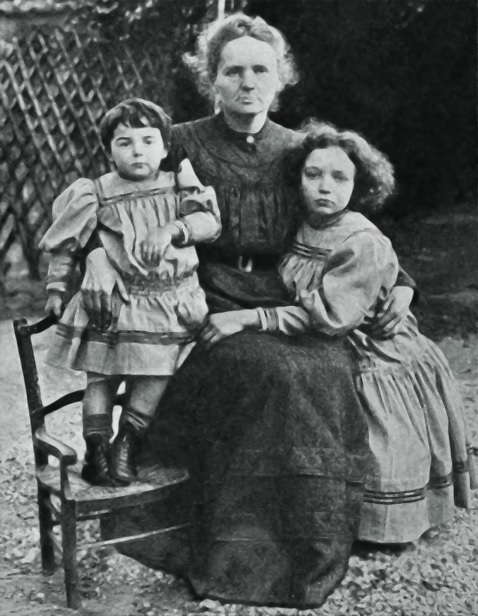
Wellcome Library, London Portrait of Marie Curie, and her two daughters, Eve and Irene, 1908 From: Madame Curie By: Curie, Eve 4.0 http://creativecommons.org/licenses/by/4.0/
There are few things people hold closer to their hearts than the education of children. Disagreement arises not about the goal, but on how to achieve that goal.
Theories about education don’t evolve; they erupt. Most people understand that childhood offers a unique opportunity to influence minds for a lifetime. Maybe this explains the furor that has accompanied the Common Core roll-out in communities across the US. While the trend toward rigid standards, uniform curriculum and increased formal instruction seems sound to some, to others it seems a travesty, a squandering of childhood’s most precious gifts: play, imagination and exploration. Included in this latter camp would surely be Marie Curie, mother of two girls.
If she were alive today, Marie Curie would likely be dismayed to see the imposition of rigid learning modalities on young children.
Marie’s views on education were described by her daughter, Eve. In the acclaimed biography, Marie Curie, Eve recalled that her mother dreaded sending her children into the sterile, confining atmosphere of a structured classroom. The Nobel Prize-winning scientist regarded formal schooling as “hours of attendance”. Curie’s philosophy was that children should be encouraged to find their talents through exploration. It was in this way that Irene, the older daughter, early discovered an interest in mathematics. In like manner did Eve learn that she had a talent, and a passion, for music.
Essential to the daily regimen of both Curie children was vigorous physical activity. Marie installed gym equipment at home and took the girls on camping trips. Together the family biked across the countryside on extended expeditions. “Formal” instruction was put off for as long as possible. To replace this instruction, Marie devised a scheme with her colleagues at the Sorbonne.
The two Curie girls, along with several companions, would be exposed to the finest minds at the university. Each day the children–they were affectionately called ‘little monkeys’– would spend hours with a professor from one discipline. On succeeding days they would rotate to other classrooms. The weeks would pass in this way, with the children engaged in a casual rotation between specialists in various fields. There was no regimentation, no pressure. Learning was accomplished in a stimulating, cheerful environment.
The time did come when Marie’s daughters were obliged to attend formal classes. They apparently adjusted well after what some might regard as a bohemian introduction to learning. Irene eventually earned a Doctor of Science degree and Eve earned two bachelor degrees, one in philosophy and one in music.
Irene went on to win a Nobel Prize in 1935 and later continued to do groundbreaking research in nuclear physics. Eve tried her hand at a number of pursuits. She was a concert pianist, journalist, diplomat and humanitarian.
Irene died in 1956, Eve in 2007. It would difficult to imagine two more accomplished sisters. Did their mother’s approach to education lay the groundwork for the extraordinary achievements of these women? Impossible to say. What is certain is that Marie’s approach to education did not impede her children’s development. It might even be suggested that the accomplishments of the Curie sisters help to support the argument against a rigid academic curriculum. Certainly, the example of these women offers the possibility that a rigid curriculum may not be the only, or even the best path to a successful future.




 Rhythm Prism Publishing