Publishing Your Book

By A. G. Moore

Banyan tree,_Efate,_Vanuatu,_13_April_2008_-_Flickr_-_PhillipC
Banyan tree: Efate, Vanuatu, 13 April 2008 Author: Phillip Capper from Wellington, New Zealand Used under Creative Commons 2.0 Attribution license

I’ve just finished another book.  If you’ve ever written one, or attempted to write one, you know this takes a lot of patience and effort.  In my case, research is a major part of the process. It doesn’t matter if I’m writing fiction or nonfiction, I always do background work.

There was a book of fiction I wrote once that referred to an unspecified island. The setting needed to be pristine, a place where both humans and the earth were in a primitive state.

To make my story believable, I researched the history of New Zealand (worked for Peter Jackson, didn’t it?).  The origins of the Maori and their traditions became the cultural template upon which my characters were built. Even the tree in my story was believable.

That book (a little over 85,000 words) was shelved and never will again see the light of day. No matter.  I learned, not only about New Zealand and banyan trees, but also about writing and publishing.  As I look back on my 85,000-word book and the difficulty of physically preparing it for publication, I smile. So much of what I do routinely now was a struggle back then.

While it’s true there’s nothing like experience and each of us has to learn by doing, it’s also true that information can be shared.  That’s what this blog is about.  I’m sharing some hard-earned information about self-publishing. There are no writing tips in this post, except for the basic suggestion that we should keep at it.  Information is limited to my experience only and may not help anyone else. That said, this is what I’ve learned.

Three formats that have been indispensable to me are Amazon Kindle (ebook), Amazon CreateSpace (print), and Smashwords (ebook).  The print format is the easiest because it is the most literal; that is, what you see in the PDF conversion is likely what you will see in print. Documents have to be uploaded as PDFs in order to be processed by CreateSpace for publication.

Both Kindle and Smashwords require a little more TLC, which some authors seem to resent. They seem to resent especially the formatting demands made by Smashwords.  Let me be upfront about this attitude: What?

I wrote an 85,000-word book and can’t take the time to format it properly?  Doesn’t make sense to me.

Every book I’ve ever published (and unpublished–there have been a few of those) has been formatted for SmashwordsSmashwords is a powerful distribution tool.  Apple, Sony, Kobo, Barnes&Noble–the list goes on.  All of these vendors receive books from Smashwords.  The trick to getting your work into the hands of these vendors is to format it in a very precise way.  If you do that successfully, Smashwords puts your book in the “Premium Catalog” and the world opens up.

So why do many authors give up on Smashwords?  I don’t know.  I figured out long ago to keep things simple for this publisher.  Limit exotic formatting.  Give up on stylistic quirks that you think might make your book attractive. Not worth it. And, if you have pictures, make sure they are at a low resolution (96 dpi) and that they are anchored to the page “as character” (in Open Office, which is what I work in).

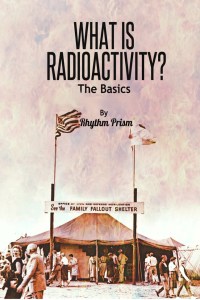
Smashwords issues a Style Guide.  The book is free and very detailed.  Follow the rules in that book and you should have little trouble.  Of course, my last book, What Is Radioactivity? The Basics, was uploaded six times before I got it right.  But that took maybe a couple of hours.  Took a lot longer to write the book.

Kindle has its own distinct formatting issues. One tip I picked up a long time ago was to indent each first line in a paragraph by .01.  Failure to do this results in some pretty weird stuff, especially if you have block formatted your piece, as I always do.  .01 is barely visible to the eye and yet it keeps Kindle from messing with the block style I desire.

As with Smashwords, anchor your pictures “as character” or they are likely  to float into odd places.  Kindle doesn’t seem to mind bold or varied font size.  By all means, if you want a clean page break, then indicate that in the formatting menu on your toolbar.

I’ve noticed that my books do not look as good in the Kindle version as they do in the Smashwords version or in print.  My last book (the one on radioactivity) was uploaded ten times before it looked acceptable on Kindle.

Finally, proof your copy after you’ve uploaded in each format. Unpleasant surprises are likely to show up. These include not only peculiarities of formatting, but also your own human error.  In this last book, for example, I had published and proofed thoroughly three versions: Kindle, Smashwords and Createspace.

I read through one more time, while the books were live, and was horrified to see that I had referred to ‘nineteenth’ century scientists as ‘eighteenth’ century scientists.  I know very well what ‘eighteenth’ century and ‘nineteenth’ century mean, but that did not prevent me from making this egregious error.  I had to pull all the books down and correct.

As I write this post, I’m looking forward already to my next project.  For me, book-writing is a release from reality, although, the irony is that I mostly write about ‘real’ things.  There are a lot of ideas floating around in my head right now.  One thing certain is that my next subject will not be familiar to me. That would be too easy.  I guess I’m like a marathon runner who has to keep testing limits.  There is one difference, though. At the end of a race, a marathoner has memories, and a very tired body.  At the end of one of my projects, I have a book, and a very tired body.

Check out my latest book, if you have a chance. It’s pretty good, I think. Available in print (of course) and ebook on Smashwords and Kindle.  Two versions of the book are offered: one has a workbook included for students with solid reading skills. The other version is suitable for anyone who knows little about radioactivity and would like to understand the history and science of it better.

One more point: I can write a book and publish a book. When it comes to marketing, that’s a blog someone else will have to write.
what is radioactivity for wordpress

Parallel Lives, Two Realities: Rachel Jeantel Speaks

By A. G. Moore

I wrote this blog about two years ago. It addresses the testimony of  Rachel Jeantel, witness at George Zimmerman’s murder trial.

As I listen to the commentary about Rachel Jeantel and her digressions from “standard” English, I wonder about the collective blinders her critics are wearing–and about their determined avoidance of the obvious issue raised by Ms. Jeantel’s usage: parallel cultures exist in the U.S. because of economic, social and racial isolation.

In 1912, George Bernard Shaw wrote a play called Pygmalion, which has enjoyed more recent incarnations as My Fair Lady. Most of us know the story: a young woman is taken from the poor precincts of London and groomed to pass as a member of the British upper class. Foremost in this process is a transformation of the woman’s almost incomprehensible cockney dialect into the more refined vernacular of the British ruling class. In a sense, Shaw wrote the story of Rachel Jeantel’s testimony in a Florida courtroom long before she was born. That’s because the story is as old as social organization itself. People arrange themselves into insiders and outsiders (see my blog on Robert E.Park). Class hierarchies are formed based on conspicuous differences

In 2011, John Logan and Brian Stults, of Brown and Florida State Universities, analyzed the results of the 2010 U. S. census. The researchers came up with interesting results. While a few cities, such as New York and St. Louis, showed a decline in segregation, others showed an increase. Among the more segregated cities was Miami, which, according to the Logan/Stults analysis, became significantly more socially and culturally divided between the 2000 and 2010 censuses.

The New York Times published its own analysis of segregation trends in the U. S. and the relationship of these trends to social mobility. The article described how some cities had intrinsic geographic barriers to social mobility and how these barriers impeded the ability of groups to move from one income class to another. The city highlighted in the article was Atlanta, Ga, but Miami was also given a poor social mobility score.

So what does this have to do with language? Well, besides what we all know instinctively as we accept Shaw’s Pygmalion story line, there’s a body of research which describes how dialects evolve within a society. Racially and socially isolated communities develop distinct cultures. Linguists look at the isolation of different groups and their social cohesiveness to assess whether or not the trend in that group would be to adopt standard language forms or to adhere to a non standard dialect. One study, carried out in Reading, England, is enlightening.

There is a phenomenon called “leveling” that has to take place if a dialect is to slowly disappear. Leveling simply means that differences between regional dialects and standard forms of language flattened so that one blends into the other. A couple of factors work against leveling. One of them is lack of social mobility: if groups do not have contact with one another then there is not likely to be the influence on language which would bring about leveling. This conclusion pretty much makes sense to even the non-scientist. However, there is another factor which has an impact on leveling: group cohesion.

The researchers looked at groups from different economic sectors who lived in essentially the same geographic setting (Reading). It turns out that lower income people tender to cling more tenaciously to group identity and part of group identity is language. As the researchers see it, this tendency to remain within a group is related to individual survival. Poorer people feel less secure and  need the support structure of their group. As incomes increase and survival becomes more certain, group support becomes less important and people are inclined to let go of group identifiers, such as language. In times of stress, mutual support of group members becomes essential and this is a kind of glue which reinforces group characteristics.

Now, back to Rachel Jeantel, who has lived in Miami for all of her 19 years. As the data shows, Miami is a city with a low social mobility quotient. Group identity is likely to be strong. Ms. Jeantel delivered her court testimony in mostly non-standard English. She delivered it in the vernacular of her group, of her community. Many who heard her took her lack of standard usage as a sign that she was not intelligent. But besides her usage, nothing about her presentation suggested a lack of cognitive alertness. She held her own against an aggressive and demeaning lawyer, someone skilled at courtroom interrogation. She delivered consistent testimony. Her thought process was not muddled.

While I cannot discuss Ms. Jeantel’s individual life circumstance–for I know very little about it–I can say that the English dialect she used is, like all dialects, a product of long-standing social and economic factors.

John McWhorter, linguistics scholar at Columbia University in New York, says of Ms. Jeantel: “…her English is perfect. It’s just that it’s Black English, which has rules as complex as the mainstream English of William F. Buckley.” Dr. McWhorter then goes on to explain the rules that govern Black English–rules Ms. Jeantel apparently commands very well.

Black English, the variation of standard English used by Rachel Jeantel, is an established dialect. It is as legitimate as other established dialects, such as Cockney (England) or Hiberno-English (Ireland). What many who listened to Ms. Jeantel’s testimony forgot was this: just because someone doesn’t talk like you doesn’t mean they’re not smart like you. And to think otherwise is to show your lack of sophistication, not theirs.

Marie Curie: A Life Illuminated by Intelligence, Determination and Courage

Marie_Curie-Laboratory before 1937 author unknown
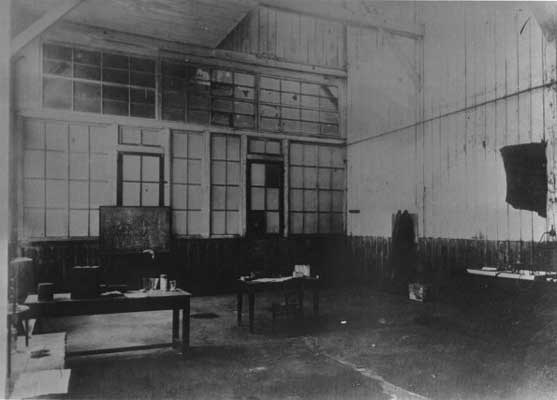
A picture of Marie Curie’s laboratory where she did much of her work on radium.

When we read about famous historical figures their accomplishments seem obvious, their acclaim assured. Closer examination often reveals a different story. Marie Curie, for example, almost didn’t get her first Nobel Prize. Even after winning the prize, she and her husband struggled to find appropriate laboratory space in which to conduct their experiments. And, though Marie Curie was the first woman to hold a professorship at the Sorbonne, she was only given that position after her husband’s became vacant because of his death.

Most modern observers marvel at Marie Curie’s intelligence and insight. A review of the obstacles she overcame suggest that perhaps her most influential traits might have been determination and courage. Marie had faith in her own abilities, but stronger than that was a conviction that her work was important.

Albert Einstein once described Marie Curie as someone who was totally indifferent to fame. She was a scientist. She did hard, grinding labor. She extracted radium and polonium from pitchblende; the yield of this extraction was in minute quantities. The exquisitely slow pace of the process did not deter Marie. She endured physical consequences of her effort–radiation burns and fatigue–without complaint.

When World War I broke out, Marie Curie used her scientific knowledge to save lives. She designed portable x-ray units and traveled to the front so she could offer her services to wounded soldiers. Marie Curie did this as she did everything else in her life, with courage, intelligence and a lack of regard for herself.

As we read about Marie Curie, and other accomplished figures in history, we marvel at what they achieved. Often, however, the better part of their story may be the road they traveled to realize their achievements. The strength of character displayed in some cases–certainly in Marie Curie’s case–is certainly as noteworthy as the honors earned.

********************************************************

Two books issued by Rhythm Prism are dedicated to Marie Curie’s life. One, Marie Curie: Radium, Polonium, is designed for a general audience and the other, Marie Curie: Science Pioneer,  addresses the interests of children.  Material in both books overlaps, although specialized information about Polonium and Radium are contained in Marie Curie: Radium, Polonium.

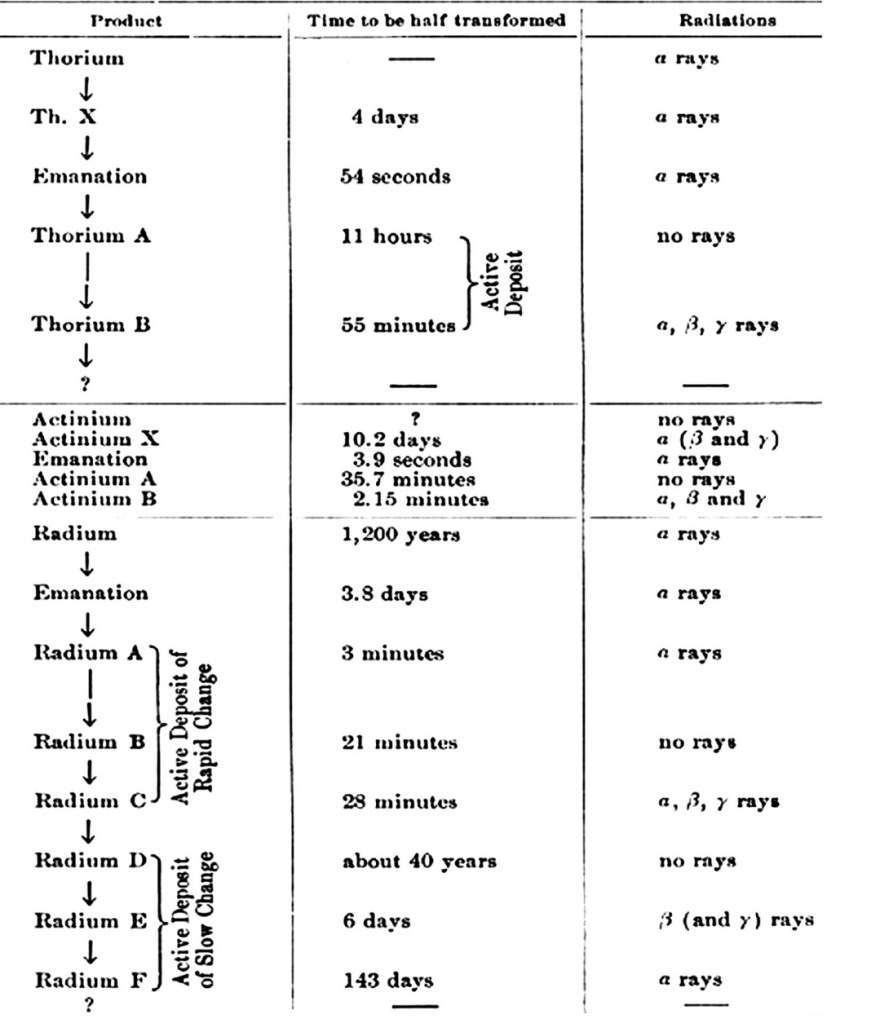
Marie and Pierre Curie discovered two elements on the periodic table, radium and polonium. One of the difficulties they had in working with polonium was the fact that it kept “disappearing”.  What they did not understand at the time was that radioactive elements decay at a regular rate, called its half life.  Below is a chart (which appears in the Rhythm Prism book Marie Curie: Radium, Polonium) that shows the process of thorium decay.  The chart was the work of Ernest Rutherford, who was himself a Nobel Laureate.

thorium chart

Marie Curie: Radium, Polonium and Marie Curie: Pioneer in Science are written in very basic language.  If you’re interested in gaining a rudimentary understanding of radioactivity and learning about Marie Curie, both books will serve that purpose.

General Interest Book

marie and atom 5 cover smash site

Children’s Book (with study guide)

BeFunky_Marie for site

 Another book that introduces more information about radioactivity is the Rhythm Prism publication, What Is Radioactivity? The Basics.  This book is offered in  6 by 9 and  8 1/2 by 11 workbook version. Reading level is adult or mature student.

what is radioactivity front  cover 6 by 9 print site