The Great Famine of 1876, India


British rule in India dated from 1757, when the British East India Company, under Lord Clive, defeated the Nawab of Bengal at the Battle of Plassey.  British rule did not end until the Indian Independence Act of 1947 was passed.  In the almost two hundred years between Plassey and the Independence Act, India suffered a series of devastating famines.  While perspectives on the causes of the famines vary, there is little doubt by historians that colonial policy contributed to the enormous loss of life.

India was once called the Jewel in the Crown of the British Empire.  Great riches were extracted from the colony.  Many landed estates were financed by wealth gained from the subcontinent.  Millions of lives may have been the price India paid to produce this profit.

The Famine   

The Famine of 1876  was not the first or last suffered by the Indian people.  Also called the Madras Famine, it occurred essentially in southern and southwestern Indian states.  Most historians blame British colonial policy for contributing to the suffering.  While some observers suggest that famine would have occurred in any event because of natural conditions, there is little doubt that British actions turned the famine into a greater catastrophe than it might otherwise have been.

famine
This picture is cropped from a larger photo taken by Willoughby Wallace Hooper in 1876. The larger photo was not used here because it was even more graphic.

The images of emaciated people in the photo above were recorded during the famine, which lasted approximately from 1876 – 1878.  It is not known whether any of the people in the photo survived.  The 1876 Famine is distinguished from some that came before in that there is an extensive photographic record of the events.


Estimating the total death toll of the famine is difficult.  Some historians say five million perished; others put the number of deceased closer to ten million.  In addition to those who died, millions suffered severe malnourishment, the effects of which likely lingered for the rest of their lives.


It is believed that long-term and short-term policies of British rule helped to precipitate the famine and to exacerbate its drastic effects.  Grains that could have fed the people were routinely sent out of the country.  Lands that might have grown food for the people locally were converted to plantations dedicated to cash crops.  These crops were sent abroad.


The Viceroy of India at the time of the famine, Lord Edward Lytton, did little to alleviate suffering.  It is overwhelmingly the judgment of history that Lytton’s actions caused the death of millions.  Lytton declined to institute an aggressive relief program.  Not only did he not distribute sufficient foodstuffs to the starving, he also continued to export grains that could have fed them.  At the height of the famine, a record amount of wheat (6.4m hundredweight) was exported to England.


It is certain that Lytton was motivated by a desire to see that India continued to yield a profit for the Crown; however, there was likely a secondary motivation, perhaps as strong.  Lytton was being true to a philosophy called Social Darwinism, which held that in a natural order, the strongest survive and the weakest are winnowed out.  It is this winnowing, Social Darwinists believed,  which is nature’s way of strengthening the population as a whole.  By allowing millions to starve, therefore, Lytton was accommodating a natural process that in the end would be of benefit to society.


After his service in India, Lord Lytton enjoyed a distinguished diplomatic career.  He became Earl of Lytton and Viscount Knebworth.  Among his contemporaries he also enjoyed a solid reputation as a poet.  Upon his death in Paris (1891) he was granted the extraordinary  honor of a state funeral.
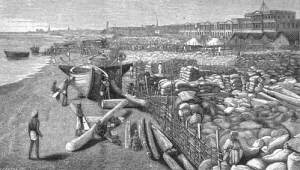
grain on the port of Madras
The lithograph by William Digby is based on a photograph by Willoughby Hooper. Digby wrote about the Great Famine in his book, The Famine Campaign in Southern India, 1878. This picture shows grain piling up on a Madras beach as it is readied for export to England.

The material in this essay was modified to match the reading skills of an adult audience. The original essay was written with vocabulary and sentence structure that were less challenging.

Another blog on this site that was adapted from The Modern British Empire: The Massacre at Jallianwala Bagh


………………………………………………………………

While it is true that Britain once was the greatest sea  power on earth and had an empire that stretched across the world, other European nations also had colonies.  In each case, there was evidence of indifference to life and the cultures of indigenous peoples.   The British, for a time, were more successful at conquering and colonizing, but no more brutal.  Italy, for example interned thousands in a Libyan concentration camp and has been charged with using poison gas in its attempt to secure African colonies.  France routinely used conscripted labor in their various colonial enterprises.

The stories of indigenous peoples under European colonialism could fill many books.  A. G. Moore has attempted to tell some of those stories in richly illustrated book (172 pages), Exploration and Conquest: Stories of Indigenous Peoples.   This book can only touch the surface of a complex and tragic history, but it does provide readers with a true impression of the European colonial era and the toll it took on indigenous people around the world.

exploration-cover-rev-site


Demystifying Book Writing, Part I

accent picture creating

For most of my life writing a book seemed out of reach.  Sometimes I would begin to write, but then couldn’t hold onto the idea.  I felt as though I was grabbing a handful of sand.  My project had no cohesion and the objective quickly fell out of view.  The problem of constancy ended on the day I decided to write about something very specific; I kept that clear goal in mind through to the end of the project.

Writing my first book was a struggle.  Though the sense of holding sand was gone, I still lacked technique.  The endpoint at least gave me something to head toward but this vision was not a compass.  Many times I got lost and wasted time exploring tangents.

Producing my book was difficult, but instructive. The experience  taught me that book writing is like any skill;  it can be developed even if the spark of genius is absent.

For me, the first obstacle to writing was psychological.  I needed to overcome the belief that my book had to be a masterpiece.  I came to the understanding, as years passed, that a masterpiece probably wasn’t ever going to happen for me.  This realization wasn’t depressing; it was a license.  Even if my words would not be immortal, they could still be effective.  Being effective might just be enough.

Once I swallowed this bit of realism, I asked myself why I wanted to write.  Humility came to the rescue.  I enjoy it. And there’s always the possibility that my words might have influence.  These two reasons were sufficient to sustain my ambition.

Time has proven that I was correct to continue writing.  My first book was by no means brilliant, but it was serviceable and it received recognition from at least one national organization.  True, the organization wasn’t literary; it was a charitable foundation.  I’ll settle for that.

My writing has value.  If I didn’t write, that value would not exist.  Plus, I’m having a blast.  I’ve developed a skill, a knack for turning out books that are worthwhile and very readable.  The more I write, the better I get at it.

I know how to put a book together.  There are people I’m certain who are wishing, as I once did, that they could grab an idea, hold onto it and write their first book.  With this blog, and the one that will follow, I hope to give some of these aspiring writers a few clues about how to proceed.

It is not a lack of modesty that allows me to take the liberty of offering suggestions about writing.  I was once a teacher.  It is natural for me to share what I know.  As an experienced teacher I understand that some will want to listen and learn, and some will not.  But once again, humility comes to the rescue.  I’ll settle for helping just one or two people.  If my blog helps only that number, it will have been worth the effort.

Stay tuned for Part II.

Who Owns a Child?

What is the boundary between parental rights and state responsibility?  Even avowed libertarians will agree that at some point the state has an obligation to insure a child’s well-being. Difficulty arises in defining how closely the state can monitor that well-being and how the well-being is defined.  These definitions are not fixed.  Ideas about the rights of parents and children evolve.  Often, when the state steps in it does so in the name of the child, or at least that is the rationale given.  When the state fails to step in, it often takes this course out of respect for parental rights.  Unfortunately, both involvement and non-involvement can result in harm to the child.

Even if the discussion about parental rights were confined to the United States, it would quickly become apparent that there’s no universal agreement about where the state’s right to interfere in the home begins and ends.   While federal regulations exist that guide state child protection laws, interpretation of those laws varies from locality to locality.  For  example, the District of Columbia has several criteria for determining appropriate parenting.  One very specific regulation addresses the speed with which a newborn is collected from a hospital. If the child is left for “at least 10 calendar days” despite being medically fit for discharge, then the court might determine parental rights should be terminated.

The State of Georgia explicitly asserts that the preferred placement for a child is in the home:”…each child coming within the jurisdiction of the court shall receive, preferably in his or her own home, the care, guidance, and control that will be conducive to the child’s welfare and the best interests of the State…”

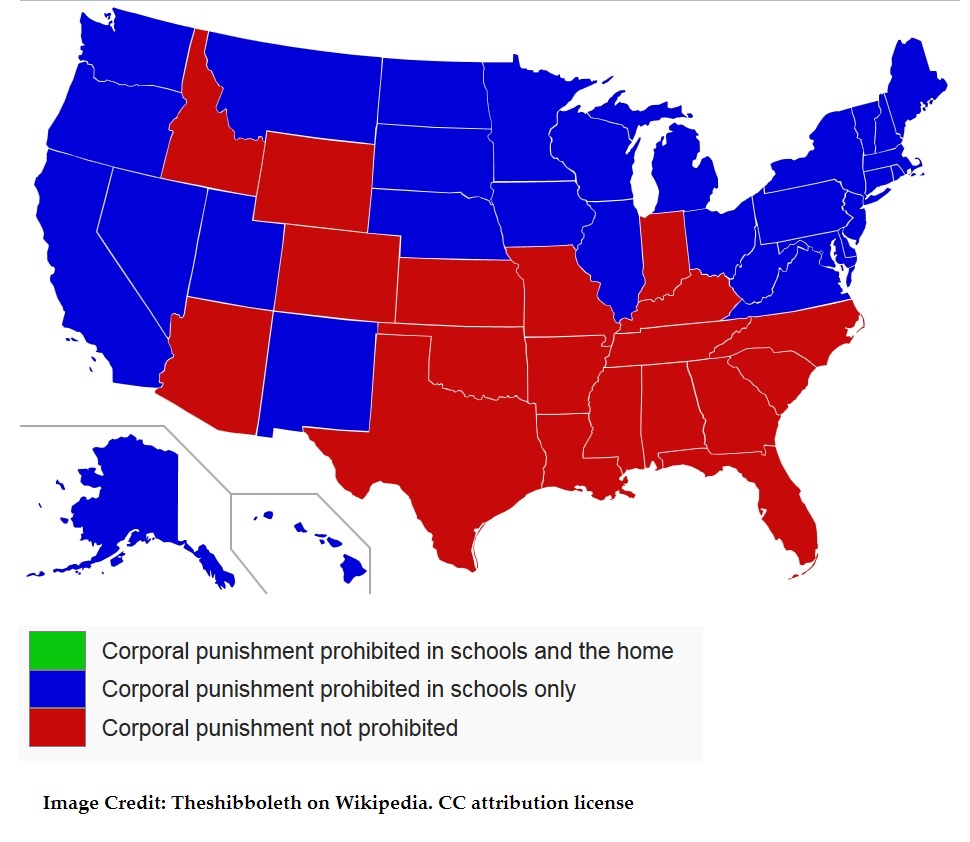
One parental prerogative on which every US state agrees is the right to inflict corporal punishment on children.  This right is exclusively reserved for parents in some states, while others allow corporal punishment to be inflicted by schools also.

Child welfare is something most people think they agree on.  However, ideas about child welfare vary from family to family, community to community.  At some point government steps in and decides when a child’s welfare has been endangered.  Communities decide on the boundary between government responsibility and parental rights.  Once the boundary is determined, a wide range of liberties may be affected.  It is hard to imagine every area where the boundaries might blur.  Certainly government is likely to assert an interest in custodial supervision, medical care and education. How that interest is expressed depends on where a family resides.  A guide to different rules in different states may be found in the publication: Child Welfare Information Gateway.

Many people don’t spend much time thinking about the ways government might intrude into family life. However, conflicts between government policy and family belief is not uncommon. This conflict may arise in families that decide to home school.  It may arise in families that decide not to vaccinate their children, or to forgo medical treatment.

Who owns a child?  All states to one degree or another are committed to protecting the welfare of children. It behooves a parent to understand the laws of the state in which the child resides, because ultimately, government is the final arbiter of where the boundary between parental right and government responsibility falls.

corporal punishment map