Sister Judy Mannix

scorpion costa rica
Sister Judy told me about some of the critters she encountered while she was in El Salvador. One of those was a scorpion. The picture above is of a Central American Bark Scorpion. Not sure if Sister Judy’s scorpions looked exactly like this.

(I have adapted this post from an older one, on another website)

I first spoke with Sister Judy Mannix in the winter of 1997.   I’d called the local parish and offered to volunteer.  Sister Judy answered my call.  And thus I came to know one of the most remarkable people I have ever met.

Before you read any further, scrub your mind clean of preconceptions about a person who chooses to live the religious life.  Though she is obviously a woman of deep faith, Sister Judy does not impose that faith on anyone.  It was several months – as  she was handing out Easter tokens in fact – before she had any idea what my religious practices were.  Although we worked together in Parish Outreach, doctrine was never an issue with us. 

The center at which we worked was a small storefront office in the middle of a troubled neighborhood.  This site was Sister Judy’s brainchild and represented her approach to a problem: bring the services to the people and get to work.  We opened our doors and word-of-mouth did the rest.  There were unpaid heating bills, poorly clothed children, undernourished families.  The list of ills was probably representative of every distressed community anywhere.

With Sister Judy’s guidance we addressed the issues.  But we also learned to do something else.  And in one incident I witnessed, Sister Judy demonstrated what that something was.

It was maybe two in the afternoon; a woman of indeterminate age came to the office.  She sat down and was vague about the reason for her visit.  A strong smell of alcohol – and other things that suggested a carelessness about personal hygiene – surrounded her.  I was at a loss and called Sister Judy from the back office because I didn’t know how to help this woman.  But Sister Judy did.

Although she had been running ragged all afternoon dealing with fuel companies and social service agencies, Sister Judy just stopped.  She sat next to our client.  Suddenly we did not have a client.  We had a guest.  Sister Judy saw a need I did not understand.  The woman craved company. This Sister Judy gracefully gave her.

Was it twenty minutes?  I don’t remember.  Nothing material was accomplished in those minutes.  Sister Judy and the woman chatted casually, as one might do with a friend.  At the end of their chat, the woman wandered away and Sister Judy returned to her intensive work schedule.

There was no discussion of religion, or doing good, before, during or after that woman’s visit.  But the whole episode demonstrated for me once and for all what Sister Judy was about.  She had turned herself into a vessel for good and as a vessel, bent willingly to the requirements of her environment.

In the past, she had traipsed across the mountains of El Salvador while civil war raged.  She taught school in Malaysia.  When I knew her she was establishing an outreach center for immigrants on Long Island.  

As to money:  every business should have Sister Judy supervising its books.  There would be no random, unexplained expenditures with her on the watch.  She has what I can only describe as a singular talent for thrift.  She sees herself as a trustee of funds.  Every penny is measured and dispensed with scrupulous care.  No valid request for assistance is denied, but every request is scrutinized to be certain that it is indeed valid.

Sister Judy changed my life, and she did it by example, not by sermonizing.  I will never be brave enough, energetic enough, thrifty enough or spiritual enough to emulate her.  But now at least I know the goal, and knowing that, I can head in the right direction.

Sister Judy is a member of the Good Shepherd order, which has its home base in Jamaica, New York. According to the 2010 issue of the Catholic Islander, the newsletter of the Catholic Diocese of St. Thomas in the Virgin Islands, Sister Judy is currently working at the Good Shepherd Center in St. Croix.

Fostering Curiosity in the Student

eclipse for site

Jonas Salk once said, in explaining his success, “I was curious...” (http://www.achievement.org/autodoc/page/sal0int-1).

In the history of human endeavor it is certainly true that more has been learned from questions raised than from answers given. The tension between theories of education seems always to come down to “traditionalists”, who believe children can learn best in formal environments, and “reformers”, who believe learning flourishes best in an environment where curiosity and imagination are encouraged.

Jonas Salk may have benefited from formal education, but he also came upon his interest in science informally. It was curiosity and a desire to help people that led him to medicine. It was curiosity that led him to investigate the link between the influenza and polio viruses.

Maria Montessori, Rabindranath Tagore, Marie Curie–even Albert Einstein  did not find a comfortable fit between inquiry and rigid learning routines. Each of these individuals was well educated, in the sense that they had access to a body of information. Each, however, forged new paths, offered new ideas, because they diverged from an established body of knowledge and explored.

The spirit of intellectual exploration cannot flourish in an environment which insists there is only one path to knowledge. This insistence imposes on the student the limitations of the teacher. A future based on the limitations of the past is no future at all.

Tagore Gallery and Blog: Featuring Original Work by Tagore and Information About His Esthetic and Life

Pictures of Rabindranath Tagore, his family and matters related to his life will be added to this page gradually.  These pictures are offered for the reader’s enjoyment.  It is hoped that more people in the West will become familiar with the work of this writer, artist, philosopher.

Tagore's_family public domain tag
Rabindranath Tagore posed with his son, his two daughters and his daughter-in-law for this picture in 1909. From the book, Rabindranath Tagore
Tagore with Astronomer Karel Hujer 1935 public domain
Here Tagore is pictured with the astronomer Karel Hujer. Hujer was a Czech who settled in the US after fleeing from the Nazis in the 1930s. An avowed pacifist, Hujer was an admirer of Gandhi and Tagore. In 1949, after both Gandhi and Tagore were deceased, he organized the World Pacifist Meetings in India. The photo was taken in 1935, by an unknown author; it is in the public domain.
Rabindranath_Tagore_Man_and_Woman3
Tagore’s painting, entitled Man and Woman. Tagore started painting after the age of 60. His brief career as a painter is discussed in the book, Rabindranath Tagore.
Einstein_and_Tagore_Berlin_14_July_1930 public domain tag
Tagore and Albert Einstein posed for this picture when they were in Berlin, 1930. From the book, Rabindranath Tagore
Santiniketan tagore gandhi 1940
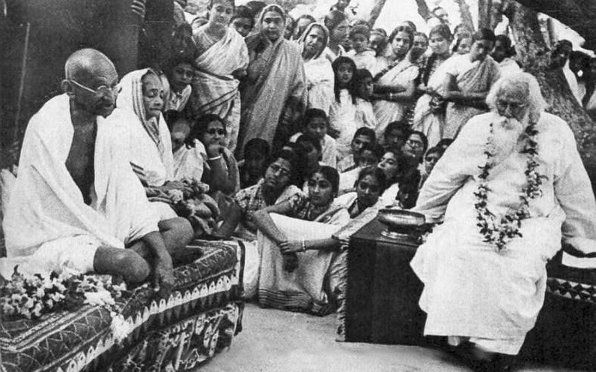
This picture of Tagore and Gandhi was taken in 1940 at Santiniketan, India. Santiniketan was the site of a university Tagore had established years before. Tagore died a year after this picture was taken; Gandhi was assassinated in 1948
Rabindranath Tagore Untitled Dancing Girl scaled
Tagore once said of his career as a painter that he was “secretly drawn” to work that came to him “least easily”. Perhaps one of his challenges was the fact that he did not see colors the way most people do. Tagore had difficulty distinguishing reds from greens. Some observers theorize that this color confusion may have explained some of the artist’s dramatic color schemes. However, with a man as complex as Rabindranath Tagore, this explanation likely oversimplifies the creative process. This picture is labeled “Untitled” and is described as being a portrait of a dancing girl. The date of the painting is unknown; it was uploaded from Wikimedia Commons and is in the public domain.
Tagore On Education
Rabindranath_Tagore_with_Mahatma_Gandhi_and_Kasturba_Gandhi_in_Shantiniketan

Rabindranath Tagore was a philosopher, artist, poet, playwright, musician and social reformer.  In 1913, he became the first non-European to be awarded the Nobel Prize in Literature.  Despite this distinction, Tagore never earned a formal academic degree.  When referring to his own education, Tagore spoke about  ‘freedom’,  not ‘discipline’.  He described his childhood home, which inspired his point of view,  as one in which “freedom in the power of our language, freedom of imagination in our  literature.. ” prevailed.  Rote learning and routinized instruction were stifling and counterproductive, in his view.

Tagore believed that education was an organic process in which the individual responded to the environment. Much in his philosophy of education resembled that of another Nobel Laureate, Marie Curie.  Both Nobel Prize winners placed strong emphasis on nature.  Both insisted on the importance of physical exercise.  And both believed that exposure to brilliant minds and brilliant work would elevate, not frustrate, a child. Both were certain that bombarding a child with structured lessons was more likely to kill an appetite for learning than to stimulate it. They believed that acquiring knowledge should be as effortless as acquiring language is for a toddler.

While Rabindranath Tagore and Marie Curie  believed that children should live in a harmonious relationship with nature, Tagore carried the theme of harmony further. He believed it was a function of education to foster harmony between people. He wanted children to be taught arts, especially music, because he thought that would enable them to develop sympathy for others. He thought that education should emphasize the progress of nations and not focus on wars and territorial conquests.

Rabindranath Tagore did not simply aspire to educational ideals: he gave them life. In 1901 he founded a school, Patha Bhavana, which embodied his principles. After he won the Nobel Prize, he invested in his school and expanded it into a university. That campus is now the site of one of the most prestigious universities in India, Visva-Bharati.

Were Rabindranath Tagore’s ideas about education misguided? Many people who work in education today apparently believe so. Increased emphasis on standardized learning and objective testing seems to be proof of that. Schools today are  laboratories in which competing theories of education are tested. As the experiment with today’s children proceeds, so will the dialogue about their future continue.

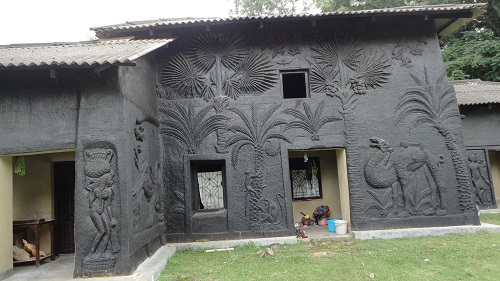
Artistic_mud_house_at_shantiniketan
For more on Rabindranath Tagore visit our page: Rabindranath Tagore
 

******************************************************************

Quotes:

It is still difficult for me to realize that I have no absolute claim to keep up a close relationship with things, merely because I have gathered them together“. From: My Reminiscences, 1917

He (my father) also knew that truth, if strayed from, can be found again, but a forced or blind acceptance of it from the outside effectually bars the way in”. From: My Reminiscences, 1917

“The west seems to take a pride in thinking that it is subduing nature; as if we are living in a hostile world where we have to wrest everything we want from an unwilling and alien arrangement of things.” From : Sadhana : The Realization of Life, 1916