Exploration and Conquest: Stories of Indigenous Peoples

exploration-matebele-cover

This post is adapted from the Introduction to the book.

Cave dwellers told their stories with vivid imagery. Through lively scenes, artists reached across ages and revealed themselves.  This was history, the story of people, of what they did and of what happened to them.

Exploration and Conquest: Stories of Indigenous Peoples is like a cave painting. It tells about people and what happened to them. The book, like the paintings, is rich in imagery. These images help readers to visualize events they have not personally witnessed.

Almost two centuries are covered in Exploration and Conquest: Stories of Indigenous Peoples. The book does not offer a detailed explanation and description of European Colonialism. What it does offer is an impression of how colonization of Asia, Africa, Australia and the Americas altered the destinies of millions of people. 

Exploration and Conquest takes the reader around the world. This is a fascinating and often tragic journey, a brief but riveting chapter in the continuing saga of humankind.

Below is one story out of many that are told in the book:

The French Keep a Foothold in Pondicherry, India
pondicherry-colonials-3-_1890
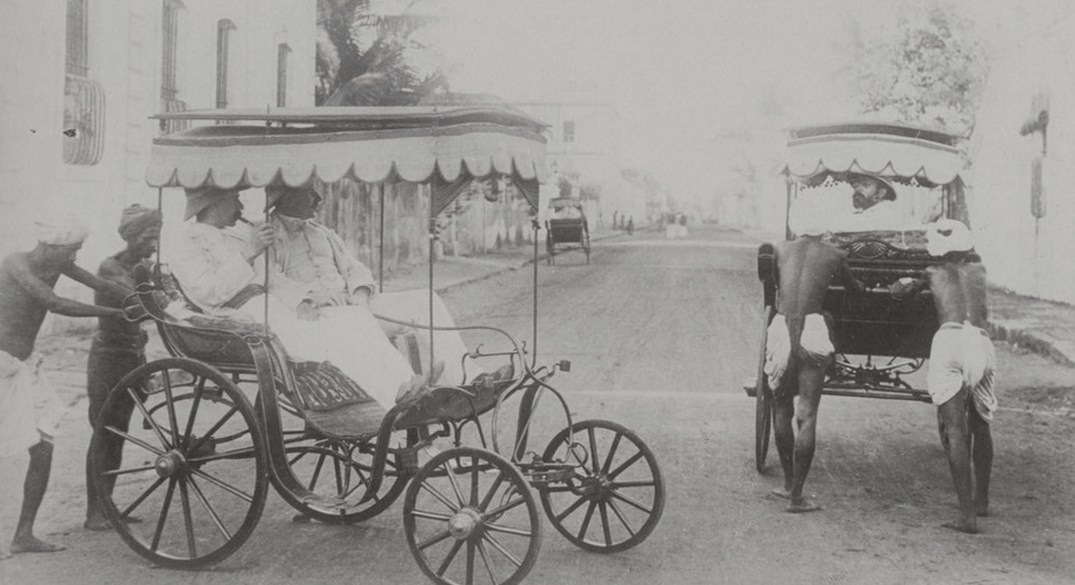
Albumen photograph by Bourne & Shepherd Studio, Calcutta, 1890, Copyright expired


While the British controlled India, the French still maintained a presence there. Called French India, the colony consisted of five small territories spread along two coasts. The largest of these was Pondicherry (today called Puducherry), on the Indian Ocean. The picture above shows French colonials as they navigate the city in carriages that use the energy of local residents, Indians, to propel them.

The French presence in Pondicherry dated back to 1672, when an agent of the French East India Company, M. Martin, bought a piece of land from the King of Bejapoor.  Martin promptly built a factory.  After that, Pondicherry was taken by the Dutch, retaken by the French, taken by the British a couple of times, and then returned to French control, where it remained until 1954.

The town was designed with a canal running down the middle. One side, called White Town, was reserved for the French and the other side, called Black Town, was reserved for Indians.

A. G. Moore   9/2016

A Burial

swamp website 2018 children fixed2
Swamp: an illustration from my upcoming memoir, Arrows Axes and Scythes

By A. G. Moore

This selection is adapted from my upcoming memoir, Arrows Axes and Scythes.

Burial

The move from Krumer’s to Lockwood’s necessitated many adjustments, some positive and some less so. The increased privacy and space were balanced by a cessation of food deliveries. The problem of decreased food supply was exacerbated by an increase in the number of mouths to feed: We began to accumulate pets. Eventually, the number grew to nine. Our pet/food imbalance became a crisis as the animals starved.

I can state with certainty that my mother asked for none of the animals. She didn’t particularly enjoy having pets, but was a compassionate person. Once a pet had been remitted to her custody, she cared for it. The animals sensed this, and they loved her.

Our pets were a hodgepodge of pedigree and mutt. Some were strays and some were delivered to our door in a misguided attempt to give the pets a home. One of these charges was contributed by my father. He found a huge animal, a St. Bernard/Great Dane mix, rummaging in the garbage behind a restaurant. This “rescued” animal, Boots, became a beloved member of the family.

Another dog was brought to the home by my mother’s brother, Jimmy. Uncle Jimmy was important to the family because he owned three dry cleaning stores in Brooklyn. He regularly gave us abandoned clothes, in excellent condition. These were the core of our school wardrobe. Uncle Jimmy’s Chihuahua, Chico, was no longer welcome in his home. That’s how we got Chico.

With nine dogs in the home, and no regular food supply, my mother tried to manage. Potatoes, delivered by my uncles, were cooked and mashed for human consumption. Peels were for the dogs.

Because hunger was their perpetual companion, the dogs took measures. They foraged in neighbors’ trash. Complaints poured in, but my mother couldn’t control the animals and she couldn’t feed them. So the neighbors, or at least one of them, took their own measures. They poisoned the dogs.

Dogs began to turn up dead. They came home to die. We discovered them in various stages of decay. It was Clinton’s job to bury the deceased, but since this was a family tragedy, everybody pitched in.

With the earth frozen, burial was a particular challenge. Clinton’s solution? A bog, a quicksand pool, he found in the forest. In the picture below, the scene of a burial is depicted, as I recall it. This memory is clear.

We dragged our dog, Hortense, up to the bog. Clinton threw her, as respectfully as he could, onto the mud and we waited for her to disappear. In a very little while the surface was smooth again and Hortense was no more.

Why Are You a Writer?

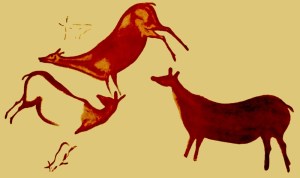
cave art La_Pasiega-Galeria_A-Ciervas_(panel_22)
Cave art from La Pasiega, in Cantabria, Spain; Author: Hugo Obermaier, 1913. This work is in the public domain.


The human effort to leave a record may be seen in cave art dating back 40,000 years.  What prompted these impulses?  Were early humans teaching a lesson?  Leaving a message?  Were they expressing devotion to a deity or satisfying an inchoate desire for self-fulfillment?  Unknowable as the answers to these questions are, so too, for many of us, is the answer to the question, “Why are you a writer?”

Writing is certainly not the most dependable way to earn money.  And it is a career that carries with it the risk of severe, personal criticism.  So, why write?

I have been writing since I was a child.  For me, writing is a way to communicate.  There are other paths to communication–music, art and dance, for example.  Sadly these avenues are not open to me.  Though I express myself with joy through many art forms, I don’t communicate well through them.  They remain my private pleasures.  Words, however, are malleable in my hands.  I mold them, sometimes nimbly, until they convey my intentions in a way that others can understand.  That’s communication.  That’s why I write.

Was I born a writer?  There’s a school of thought that holds some people are born artists and some are not.  I’ve never subscribed to this view.  Give children crayons and they color.  Read nursery rhymes to them and they respond to the cadence of words.  Creativity and art, I believe, are intrinsic to human nature.  Talents vary, as do life influences and opportunity.  The role each of these played in my choice to write–that is impossible to sort out.

I’m a writer.  I’m comfortable in the role and believe I understand the reasons for my choice.

Why are you a writer?