Demystifying Book Writing, Part I

accent picture creating

For most of my life writing a book seemed out of reach.  Sometimes I would begin to write, but then couldn’t hold onto the idea.  I felt as though I was grabbing a handful of sand.  My project had no cohesion and the objective quickly fell out of view.  The problem of constancy ended on the day I decided to write about something very specific; I kept that clear goal in mind through to the end of the project.

Writing my first book was a struggle.  Though the sense of holding sand was gone, I still lacked technique.  The endpoint at least gave me something to head toward but this vision was not a compass.  Many times I got lost and wasted time exploring tangents.

Producing my book was difficult, but instructive. The experience  taught me that book writing is like any skill;  it can be developed even if the spark of genius is absent.

For me, the first obstacle to writing was psychological.  I needed to overcome the belief that my book had to be a masterpiece.  I came to the understanding, as years passed, that a masterpiece probably wasn’t ever going to happen for me.  This realization wasn’t depressing; it was a license.  Even if my words would not be immortal, they could still be effective.  Being effective might just be enough.

Once I swallowed this bit of realism, I asked myself why I wanted to write.  Humility came to the rescue.  I enjoy it. And there’s always the possibility that my words might have influence.  These two reasons were sufficient to sustain my ambition.

Time has proven that I was correct to continue writing.  My first book was by no means brilliant, but it was serviceable and it received recognition from at least one national organization.  True, the organization wasn’t literary; it was a charitable foundation.  I’ll settle for that.

My writing has value.  If I didn’t write, that value would not exist.  Plus, I’m having a blast.  I’ve developed a skill, a knack for turning out books that are worthwhile and very readable.  The more I write, the better I get at it.

I know how to put a book together.  There are people I’m certain who are wishing, as I once did, that they could grab an idea, hold onto it and write their first book.  With this blog, and the one that will follow, I hope to give some of these aspiring writers a few clues about how to proceed.

It is not a lack of modesty that allows me to take the liberty of offering suggestions about writing.  I was once a teacher.  It is natural for me to share what I know.  As an experienced teacher I understand that some will want to listen and learn, and some will not.  But once again, humility comes to the rescue.  I’ll settle for helping just one or two people.  If my blog helps only that number, it will have been worth the effort.

Stay tuned for Part II.
Who Owns a Child?

What is the boundary between parental rights and state responsibility?  Even avowed libertarians will agree that at some point the state has an obligation to insure a child’s well-being. Difficulty arises in defining how closely the state can monitor that well-being and how the well-being is defined.  These definitions are not fixed.  Ideas about the rights of parents and children evolve.  Often, when the state steps in it does so in the name of the child, or at least that is the rationale given.  When the state fails to step in, it often takes this course out of respect for parental rights.  Unfortunately, both involvement and non-involvement can result in harm to the child.

Even if the discussion about parental rights were confined to the United States, it would quickly become apparent that there’s no universal agreement about where the state’s right to interfere in the home begins and ends.   While federal regulations exist that guide state child protection laws, interpretation of those laws varies from locality to locality.  For  example, the District of Columbia has several criteria for determining appropriate parenting.  One very specific regulation addresses the speed with which a newborn is collected from a hospital. If the child is left for “at least 10 calendar days” despite being medically fit for discharge, then the court might determine parental rights should be terminated.

The State of Georgia explicitly asserts that the preferred placement for a child is in the home:”…each child coming within the jurisdiction of the court shall receive, preferably in his or her own home, the care, guidance, and control that will be conducive to the child’s welfare and the best interests of the State…”

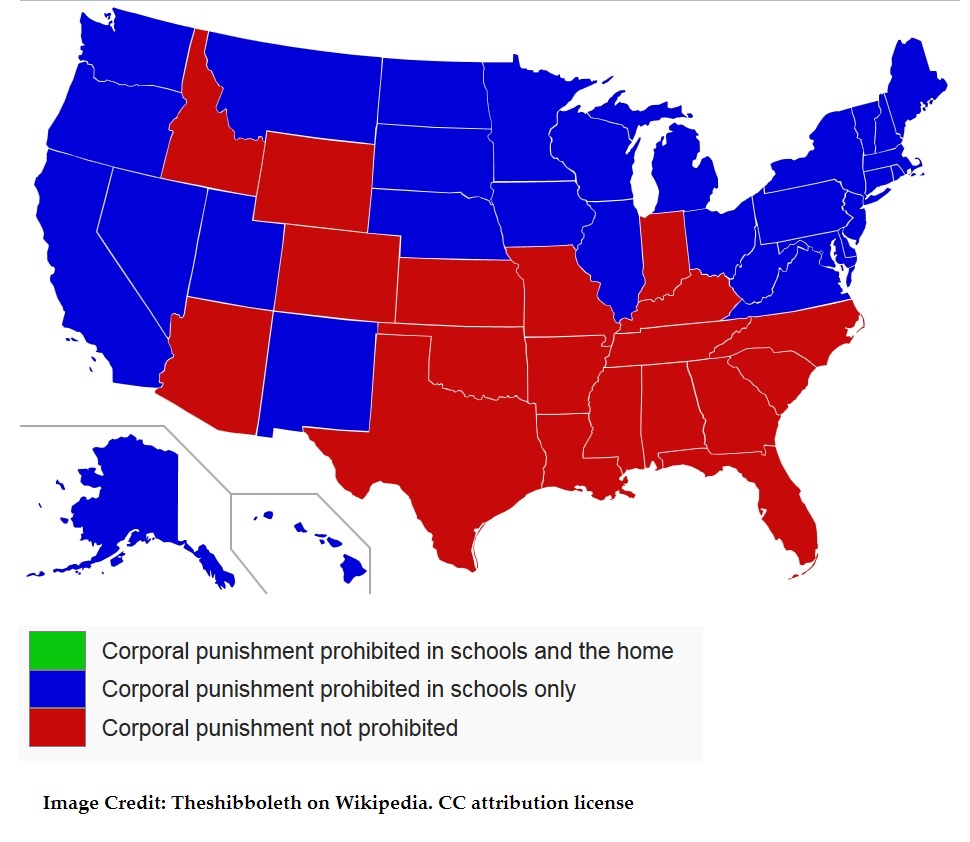
One parental prerogative on which every US state agrees is the right to inflict corporal punishment on children.  This right is exclusively reserved for parents in some states, while others allow corporal punishment to be inflicted by schools also.

Child welfare is something most people think they agree on.  However, ideas about child welfare vary from family to family, community to community.  At some point government steps in and decides when a child’s welfare has been endangered.  Communities decide on the boundary between government responsibility and parental rights.  Once the boundary is determined, a wide range of liberties may be affected.  It is hard to imagine every area where the boundaries might blur.  Certainly government is likely to assert an interest in custodial supervision, medical care and education. How that interest is expressed depends on where a family resides.  A guide to different rules in different states may be found in the publication: Child Welfare Information Gateway.

Many people don’t spend much time thinking about the ways government might intrude into family life. However, conflicts between government policy and family belief is not uncommon. This conflict may arise in families that decide to home school.  It may arise in families that decide not to vaccinate their children, or to forgo medical treatment.

Who owns a child?  All states to one degree or another are committed to protecting the welfare of children. It behooves a parent to understand the laws of the state in which the child resides, because ultimately, government is the final arbiter of where the boundary between parental right and government responsibility falls.

corporal punishment map

The Birthday Effect: Firm Cut-off Age for School Admission May Impose a Lifetime Disadvantage

School_Classroom
This is a picture of Bedford School, which is listed in the National Register of Historic Places. The school, located in Dallas/Fort Worth, Texas, was built in 1915. Picture credit: Andrew Postell, 2014, Creative Commons Attribution license.

Educational program design would likely not be controversial if children were interchangeable parts, if they were like components on a factory assembly line.  In that case, different children could be placed in the same seat every year and have  a predictable and consistent outcome.  Traditional educational models seem to be predicated on the assembly line model. Children are expected to bend to the system; the system does not accommodate the individual.  One area where inflexibility has apparently resulted in measurable harm is in age cut-offs for kindergarten admission. Longitudinal studies show that younger students, as a group, perform more poorly on achievement assessments than their older classmates.  Called the  ‘birthday effect’, a strict age cut-off policy results in a kind of age lottery. Winners of the lottery are rewarded with lifetime benefits, benefits that are evident in areas outside the academic sphere.

study out of England, for example, demonstrates the disadvantage suffered by younger children in early school years and in their later academic careers.  Members of the younger group are less likely to attend university than their older peers; if they do go to a university, it is likely that they will matriculate at a low-tier institution. The age cut-off in England is fixed firmly at September 1, which is the beginning of the school year.  Consequently, the youngest children in a grade are those born in August. Called ‘August children’, these students statistically perform more poorly than their older classmates in tests that look at academic achievement and ‘happiness’.

There are educators who do not find these study results persuasive. The former Chief Inspector of Schools, Sir Chris Woodhead, for example, believes it would be wrong to make all children”‘comfortable”.  In commenting on the  findings about firm age cut-offs, Sir Woodhead declared, “If kids are always completely confident and comfortable, they aren’t going to make much progress.”

A debate about the ‘birthday effect’ has been examined by systems outside of England.  Norway, for example, also has a firm cut-off age for school admission. In a paper presented at Harvard University in 2004, Bjarne Strøm, a researcher from the Norwegian University of Technology and Science, discusses the birthday effect on 16 and 17 year-old students.  Professor Strom provides a detailed analysis of how early disadvantage endures throughout the academic careers of the younger student.  Professor Strom concludes, “These results suggest that more flexible enrollment rules should be considered to equalize the opportunities of the children”.

Yet another study, cited on NeuroNet, addresses the impact of the ‘birthday effect’  on grade retention. This study demonstrates that the youngest children in a kindergarten class are five times more likely than their older peers to be held back in a grade. The experience of being retained in grade can have a devastating effect on the child’s psyche and future achievement.

Advocates for student discontent aside (i.e., Sir Woodhead), a growing body of research indicates that rigid adherence to age cut-offs is likely not in the best interest of children. Studies suggest that children should be evaluated, individually, for school readiness.  While this may not suit a structured, one-size-fits-all educational model, it may suit very nicely the student for whom the educational system is presumed to exist.

Bully pic blurred
One child bullying another. Studies show younger children in a class more likely to be bullied by their older and larger classmates. Public Domain Photo