Quality Schools for All

(Adapted from another site; originally published in 2012)

It’s natural to want the best for our children. So, when the New York Times runs articles about school zoning in New York City, I am somewhat sympathetic to parents who insist that their children (and therefore their neighborhoods) be included in the most desirable districts. At the same time, I am aghast at the construct of these arguments. Seemingly absent from the discussion is an awareness that it is intrinsically immoral to splice neighborhoods so that real estate values and social distinctions are reinforced.

An oft-cited rationale for gerrymandered school districts is that the middle class will stay only if its children are allowed to attend “good” public schools. Implicit in this rationale are a number of assumptions: there are not enough good schools in the system to go around; real estate values are directly related to school values; and school zoning gives the middle class some control (through their political agents) over the quality of education available to their children.

I would have little grounds for challenging these arguments if the schools in question were private and the citizens who used the private schools paid taxes into a general fund for public education. But the coveted schools are not private; they are publicly funded. The funds are not derived from neighborhoods; they are derived from city, state and federal governments.

If equity were the principle that governed school attendance, then there would not be a system which locked children into “good” and “bad” districts. Privileged parents would not be able to secure their children quality education by moving into a good district; underprivileged parents would not be forced to send their children into crime-ridden, under-performing schools.

By law, every child is entitled to free public education. The education is free in the sense that no tuition is charged, but it is not truly “free” education. Children are often not free to attend any school, but are strictly confined to a neighborhood school. In a free system, a child would be given school choice (not intended here as a euphemism for charter schools); the free market would prevail. In that case, children would presumably flee from “bad” public schools and swamp “good” public schools.

As it is, passions run high when middle class parents are faced with the prospect of losing a place in a “good” school. What does it say about some schools that parents argue so forcefully to keep their children out? It’s a civic disgrace that such discussions continue, year after year. Generation after generation parents are forced to operate in a system of rationing, with winners and losers.

Why can’t everyone be a winner?

There will always be distinctions of class and money between people. Schools are the one place where society can smooth some of those distinctions, can level the playing field so every child has a chance at a bright future. The current educational system in New York, and many cities, does not advance this goal. As long as the expectations of an elite middle class are subsidized by public funds, social and economic stratification will be reinforced, not mitigated.

The antiquated and iniquitous school districting model should be abolished. Children, and parents, should be allowed to vote with their feet. As cities adjusts to this new dynamic, perhaps the motivation will arise to make all schools “good”, instead of just those few schools that serve the  middle class elite.
Fostering Curiosity in the Student

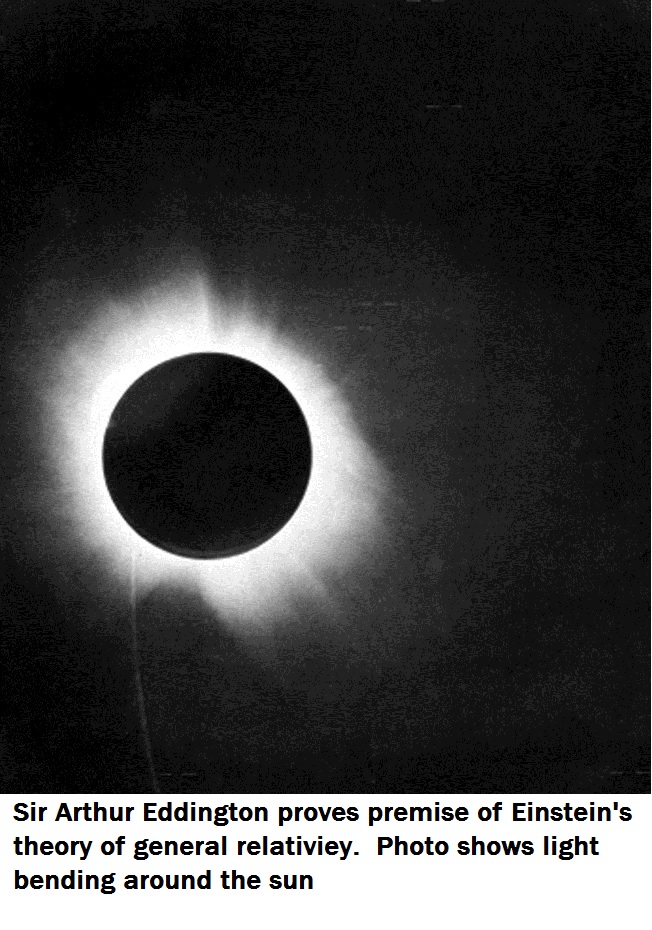
eclipse for site

Jonas Salk once said, in explaining his success, “I was curious...” (http://www.achievement.org/autodoc/page/sal0int-1).

In the history of human endeavor it is certainly true that more has been learned from questions raised than from answers given. The tension between theories of education seems always to come down to “traditionalists”, who believe children can learn best in formal environments, and “reformers”, who believe learning flourishes best in an environment where curiosity and imagination are encouraged.

Jonas Salk may have benefited from formal education, but he also came upon his interest in science informally. It was curiosity and a desire to help people that led him to medicine. It was curiosity that led him to investigate the link between the influenza and polio viruses.

Maria Montessori, Rabindranath Tagore, Marie Curie–even Albert Einstein  did not find a comfortable fit between inquiry and rigid learning routines. Each of these individuals was well educated, in the sense that they had access to a body of information. Each, however, forged new paths, offered new ideas, because they diverged from an established body of knowledge and explored.

The spirit of intellectual exploration cannot flourish in an environment which insists there is only one path to knowledge. This insistence imposes on the student the limitations of the teacher. A future based on the limitations of the past is no future at all.

Tagore Gallery and Blog: Featuring Original Work by Tagore and Information About His Esthetic and Life

Pictures of Rabindranath Tagore, his family and matters related to his life will be added to this page gradually.  These pictures are offered for the reader’s enjoyment.  It is hoped that more people in the West will become familiar with the work of this writer, artist, philosopher.

Tagore's_family public domain tag
Rabindranath Tagore posed with his son, his two daughters and his daughter-in-law for this picture in 1909. From the book, Rabindranath Tagore
Tagore with Astronomer Karel Hujer 1935 public domain
Here Tagore is pictured with the astronomer Karel Hujer. Hujer was a Czech who settled in the US after fleeing from the Nazis in the 1930s. An avowed pacifist, Hujer was an admirer of Gandhi and Tagore. In 1949, after both Gandhi and Tagore were deceased, he organized the World Pacifist Meetings in India. The photo was taken in 1935, by an unknown author; it is in the public domain.
Rabindranath_Tagore_Man_and_Woman3
Tagore’s painting, entitled Man and Woman. Tagore started painting after the age of 60. His brief career as a painter is discussed in the book, Rabindranath Tagore.
Einstein_and_Tagore_Berlin_14_July_1930 public domain tag
Tagore and Albert Einstein posed for this picture when they were in Berlin, 1930. From the book, Rabindranath Tagore
Santiniketan tagore gandhi 1940
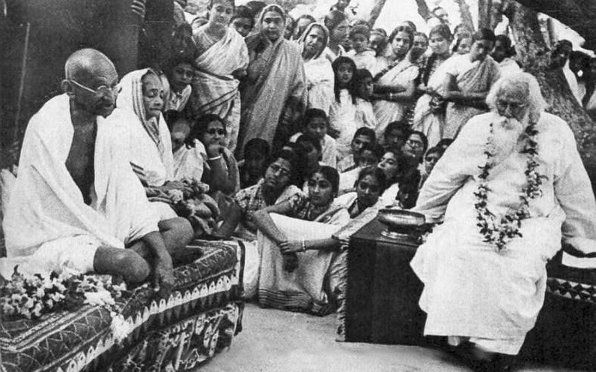
This picture of Tagore and Gandhi was taken in 1940 at Santiniketan, India. Santiniketan was the site of a university Tagore had established years before. Tagore died a year after this picture was taken; Gandhi was assassinated in 1948
Rabindranath Tagore Untitled Dancing Girl scaled
Tagore once said of his career as a painter that he was “secretly drawn” to work that came to him “least easily”. Perhaps one of his challenges was the fact that he did not see colors the way most people do. Tagore had difficulty distinguishing reds from greens. Some observers theorize that this color confusion may have explained some of the artist’s dramatic color schemes. However, with a man as complex as Rabindranath Tagore, this explanation likely oversimplifies the creative process. This picture is labeled “Untitled” and is described as being a portrait of a dancing girl. The date of the painting is unknown; it was uploaded from Wikimedia Commons and is in the public domain.
Tagore On Education
Rabindranath_Tagore_with_Mahatma_Gandhi_and_Kasturba_Gandhi_in_Shantiniketan

Rabindranath Tagore was a philosopher, artist, poet, playwright, musician and social reformer.  In 1913, he became the first non-European to be awarded the Nobel Prize in Literature.  Despite this distinction, Tagore never earned a formal academic degree.  When referring to his own education, Tagore spoke about  ‘freedom’,  not ‘discipline’.  He described his childhood home, which inspired his point of view,  as one in which “freedom in the power of our language, freedom of imagination in our  literature.. ” prevailed.  Rote learning and routinized instruction were stifling and counterproductive, in his view.

Tagore believed that education was an organic process in which the individual responded to the environment. Much in his philosophy of education resembled that of another Nobel Laureate, Marie Curie.  Both Nobel Prize winners placed strong emphasis on nature.  Both insisted on the importance of physical exercise.  And both believed that exposure to brilliant minds and brilliant work would elevate, not frustrate, a child. Both were certain that bombarding a child with structured lessons was more likely to kill an appetite for learning than to stimulate it. They believed that acquiring knowledge should be as effortless as acquiring language is for a toddler.

While Rabindranath Tagore and Marie Curie  believed that children should live in a harmonious relationship with nature, Tagore carried the theme of harmony further. He believed it was a function of education to foster harmony between people. He wanted children to be taught arts, especially music, because he thought that would enable them to develop sympathy for others. He thought that education should emphasize the progress of nations and not focus on wars and territorial conquests.

Rabindranath Tagore did not simply aspire to educational ideals: he gave them life. In 1901 he founded a school, Patha Bhavana, which embodied his principles. After he won the Nobel Prize, he invested in his school and expanded it into a university. That campus is now the site of one of the most prestigious universities in India, Visva-Bharati.

Were Rabindranath Tagore’s ideas about education misguided? Many people who work in education today apparently believe so. Increased emphasis on standardized learning and objective testing seems to be proof of that. Schools today are  laboratories in which competing theories of education are tested. As the experiment with today’s children proceeds, so will the dialogue about their future continue.

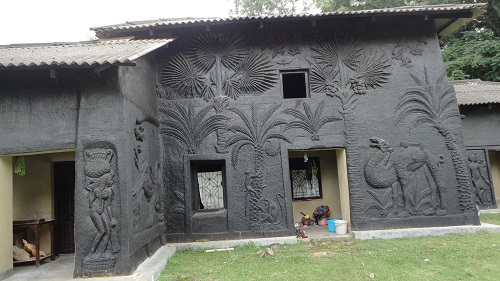
Artistic_mud_house_at_shantiniketan
For more on Rabindranath Tagore visit our page: Rabindranath Tagore
 

******************************************************************

Quotes:

It is still difficult for me to realize that I have no absolute claim to keep up a close relationship with things, merely because I have gathered them together“. From: My Reminiscences, 1917

He (my father) also knew that truth, if strayed from, can be found again, but a forced or blind acceptance of it from the outside effectually bars the way in”. From: My Reminiscences, 1917

“The west seems to take a pride in thinking that it is subduing nature; as if we are living in a hostile world where we have to wrest everything we want from an unwilling and alien arrangement of things.” From : Sadhana : The Realization of Life, 1916