How Radiation Causes Cancer

Ever since the first atomic bombs were detonated in 1945 there has been an ongoing  debate about the  hazards of exposure to radioactive material.  On one side it is argued that any exposure presents a risk to health.  On the other side it is argued that the risk of exposure is exaggerated by an anti-nuclear lobby. However, both sides agree on this point:  at very high doses radioactive material can sicken and even kill.

Below the acute level, the debate usually centers around the link between exposure and cancer. Research on the nature of this link has been a global endeavor since 1945.  In order to interpret the results of the research, a basic understanding of cancer genesis is necessary.

Simply put, cancer is the consequence of abnormal cell reproduction.  Tissue–such as skin, lungs, gut–are comprised of cells, which are themselves made up of molecules. The basic building block of a molecule is the atom.

Ionizing radiation–radioactive energy–damages cells on the atomic level (that is, it damages the atom). What this means is that the very structure of an atom–and therefore of a cell–can be altered when it is exposed to radioactive material.

Routine cell death is essential to healthy tissue. It happens all the time. There are two kinds of cell death: programmed (expected)  and traumatic (unexpected).  In either scenario, dead cells must be cleared from the bloodstream and replaced if an organism is to continue to function well. It is in the replacement of dead cells that the risk of cancer lies.

Replacement is supposed to be an orderly process. The directions for this process are contained in the cell’s DNA. But what if the DNA has been damaged and the directions for replication are garbled?  What if a replicating cell receives the wrong message and doesn’t reproduce properly?  In that event, a cell may form something that is like the original but is in some way ‘strange’.

Let’s take the liver as an example.  Liver cells replace themselves through replication.  If, however, the DNA of the replicating cells is somehow damaged, the new cells don’t come out exactly right.  These ‘strange’ cells may then survive and replicate, creating more imperfect cells, like themselves.  These ‘strange’ cells do not perform the functions of the liver, because they’re not designed to do that. And yet, they  remain in the liver, replicating, forming tissue–‘strange’, invasive tissue. That would be a cancer.

Of course there’s a lot more to cancer than this simple description suggests. But essentially, this outline describes how cancers may begin. Inherent in this process is the potential for metastasis.

In the case of metastasis (cancer has spread to another part of the body) the ‘strange’ cells hitch a ride in the bloodstream and travel to other sites in the body.  There they take root, replicate and once again become invasive. Metastatic liver cells metastasize most commonly in lymph nodes, bones and lungs.

Back to the debate about the link between radioactive material and cancer: Radioactive material interferes with cell replication because it has the ability to change the structure of an atom: it does this through ionization.  Ionization involves stripping electrons from the outer shell of an atom.  When that happens, electrons become free agents. These electrons can travel around doing mischief.  They may link with other electrons and break chemical bonds. This breakage can occur inside DNA, the critical reservoir of information for cell replication.   Damaged DNA will give the wrong instructions to a replicating cell. The consequence of this error may be the production of a cancer cell.

Of course, cancers develop in the absence of ionizing radiation. Cells make mistakes all the time. They reproduce so often that mistakes are inevitable. Sometimes the mistakes, or mutations, benefit an organism. These mutations may be kept because they may enhance the chance that a species will survive.  Sometimes, however, a mutated cell is not cast off and does not benefit an organism. The cell may take root in tissue and begin to propagate right alongside normal cells.

To be sure, the fact that ionizing radiation can cause cancer doesn’t mean it does cause cancer. This link must be proven if it is to be accepted as established fact. The proof, evidence strongly suggests, may be found in experience and data derived from that experience.

Ever since the atomic bombs were detonated over Hiroshima and Nagasaki researchers have been collecting health statistics on survivors of the blasts. About 200,000 of these have been tracked. This is a disparate group: dose levels varied greatly. There were both male and female, young and old victims.   All of the information collected on survivors–dose level, age, gender–was analyzed.  By comparing the health profiles of these individuals with profiles of those who were not exposed to the blasts, scientists believe they’re able to approximate the health risks of exposure to radioactive material.

A few things appear to be certain: there is a link between exposure to ionizing radiation and cancer.  Existence and severity of effects are dose-dependent: those who receive the highest doses are most likely to develop a cancer at some point. Age at the time of exposure is also important. The younger the person at time of exposure, the more likely  that cancer will someday develop. Gender plays a role: women experience more adverse health consequences than men.

Although the discussion in this essay is about the link between cancer and exposure to radioactive material, data from survivor studies reveals that health consequences were not limited to cancer. Among the conditions noted to occur at elevated levels in the survivors are: cardiovascular, digestive, neurological and thyroid diseases.

“Safe” dose guidelines that exist today have been derived from A-Bomb survivor studies.   It is these “guidelines” around which so much of the current debate revolves. This is a debate usually left to ‘experts’.  Perhaps, though, given the stake that everyone has in the establishment of safe guidelines, more of us should get involved in this debate. Perhaps it is time for a little self-education, because everyone is potentially affected by the decisions of the ‘experts’.  This is a conversation in which we should all take part.

For more information on radioactivity, an easy-to read book::What is Radioactivity?The Basics

what is radioactivity for wordpress

https://rhythmprismpublishing.com/what-is-radioactivity/

Growing the Brain

In a previous blog I described a study that suggested creative activity encourages brain growth. Yesterday Nature Magazine published the results of another study that looked at brain development. This one linked income level to infant brain size.

Carried out by two researchers, Kimberly Noble from Columbia University and Elizabeth Sowell from LA’s Children’s Hospital, the study showed that infants from lower income families suffer a reduction in brain size. The implications of this study are that income disparity may have life-long, potentially irreversible consequences for children. These consequences go beyond the obvious disadvantage of diminished opportunity.  Even if at some point opportunity is equalized, children from low income homes may never be able to optimally exploit it.

Most of us are familiar with the nature/nurture debate.  Essentially, this discussion weighs the influence of environmental factors such as parenting, neighborhood and schooling against inherited traits. The Nobel/Sowell study, if it holds up, invalidates the debate. According to the study, nature is not a fixed element that can be juxtaposed against environment; it is a function of environment.

The observed effect of income level on brain size is so marked that even within lower income groups, variations of a few thousand dollars result in brain size disparity. If confirmed, the results of the Nobel/Sowell study ought to have a profound effect on the political dialogue that centers on economic equity.

Of thirty-three OECD countries,Chile, Mexico, Turkey, the United States and Israel were the five with the greatest income inequality.  That inequality may translate into millions of lifetimes of relative disadvantage.  Expand the focus of the results globally and a vast population, much of the world in fact, suffers that relative disadvantage.

It is true that we all want our children to maximize the potential with which nature has endowed them. But what if that potential is not fixed by nature? What if potential is at least partly a man-made artifact, a consequence of political and economic policies that perpetuate income inequality?

The authors of the Children’s Hospital/Columbia study are careful to explain that they don’t know exactly which factors influence brain size in infants.  The researchers guess the factors might be the usual suspects: nutrition, exposure to toxins, poor social stimulation. They suggest that tinkering with manageable factors during gestation and afterwards might have a beneficial influence.

However, it seems to me that the researchers pull back from the obvious remedy: close the income gap. This prescription, though obvious, is one that many people will find ideologically unpalatable.  Whenever wealth distribution is discussed there’s inevitably talk about freedom and choice. Which begs the question, what choice is given to an infant who lies in a crib with a destiny diminished by low income? What freedom does that infant have to forge a successful future?

Of course, there’s a larger issue than the individual tragedy of lost potential.  There’s the societal cost.  Children with less potential become adults who are less able. That is not in anyone’s interest, no matter their income level.

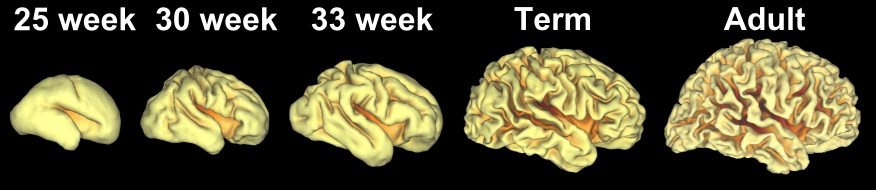
brain development
Credit for this image goes to Van Essen Lab(Washington University in St. Louis), in collaboration with Terrie Inder, Jeff Neil, Jason Hill, and others. http://brainvis.wustl.edu/wiki/index.php/Main_Page The image illustrates human cortical development through gestation and into adulthood.

Who Owns a Child?

What is the boundary between parental rights and state responsibility?  Even avowed libertarians will agree that at some point the state has an obligation to insure a child’s well-being. Difficulty arises in defining how closely the state can monitor that well-being and how the well-being is defined.  These definitions are not fixed.  Ideas about the rights of parents and children evolve.  Often, when the state steps in it does so in the name of the child, or at least that is the rationale given.  When the state fails to step in, it often takes this course out of respect for parental rights.  Unfortunately, both involvement and non-involvement can result in harm to the child.

Even if the discussion about parental rights were confined to the United States, it would quickly become apparent that there’s no universal agreement about where the state’s right to interfere in the home begins and ends.   While federal regulations exist that guide state child protection laws, interpretation of those laws varies from locality to locality.  For  example, the District of Columbia has several criteria for determining appropriate parenting.  One very specific regulation addresses the speed with which a newborn is collected from a hospital. If the child is left for “at least 10 calendar days” despite being medically fit for discharge, then the court might determine parental rights should be terminated.

The State of Georgia explicitly asserts that the preferred placement for a child is in the home:”…each child coming within the jurisdiction of the court shall receive, preferably in his or her own home, the care, guidance, and control that will be conducive to the child’s welfare and the best interests of the State…”

One parental prerogative on which every US state agrees is the right to inflict corporal punishment on children.  This right is exclusively reserved for parents in some states, while others allow corporal punishment to be inflicted by schools also.

Child welfare is something most people think they agree on.  However, ideas about child welfare vary from family to family, community to community.  At some point government steps in and decides when a child’s welfare has been endangered.  Communities decide on the boundary between government responsibility and parental rights.  Once the boundary is determined, a wide range of liberties may be affected.  It is hard to imagine every area where the boundaries might blur.  Certainly government is likely to assert an interest in custodial supervision, medical care and education. How that interest is expressed depends on where a family resides.  A guide to different rules in different states may be found in the publication: Child Welfare Information Gateway.

Many people don’t spend much time thinking about the ways government might intrude into family life. However, conflicts between government policy and family belief is not uncommon. This conflict may arise in families that decide to home school.  It may arise in families that decide not to vaccinate their children, or to forgo medical treatment.

Who owns a child?  All states to one degree or another are committed to protecting the welfare of children. It behooves a parent to understand the laws of the state in which the child resides, because ultimately, government is the final arbiter of where the boundary between parental right and government responsibility falls.

corporal punishment map