Democray and Education: A Natural Symbiosis

Some two hundred and fifty years ago Edmund Burke offered a view of government that became the basis for much of modern conservative thought.  Though Burke vigorously opposed tyranny, he was also skeptical of democracy.  He favored a kind of benign oligarchy, in which government is led by an innately superior group of individuals who sagely represent the interests of the nation.  The rest of the citizenry, “common” people, do not have, in Burke’s mind, the ability to govern or even to select their governors.  As he looked around at eighteenth century England, Burke no doubt saw validation of this civic vision.

In the England of Burke’s day, basic literacy skills eluded the vast number of people. Most of those who comprised the ruling class at the time thought this was a good thing. The British MP, Davies Giddy, for example advocated for continued illiteracy of the poor.  To educate this class of people, Giddy admonished Parliament, would teach them “to despise their lot in life”.  With access to books and troubling ideas the poor might no longer be “contented servants”.  They might even, heaven forbid, become “insolent to their superiors.”*

Of course, the English did eventually educate their poor.  And with the increase in education, the idea of shutting the lower classes out of the electoral process was abandoned.

A similar association between the development of democracy and the rise in educational achievement occurred in the United States.  Not only did electoral representation increase with a rise in national literacy, but economic opportunity likewise improved. That is, until very recently.  In the 1990’s the nation saw a curious reversal in what had previously been a steady increase in college graduation rates.  Not only was there an absolute drop in the percentage of young people graduating from college, but there was also a decline relative to other developed nations.

In 2008 The National Center for Public Policy and Higher Education tied the declining college graduation rates to affordability.  The cost of college went up, and, because of a decline in wealth, the ability of people to pay for college went down.  So today, high school graduates are often faced with a severe choice: incur onerous debt or forgo college completely.

Given the nation’s relative decline in educational achievement, one might expect a kind of call to arms in the U.S, a marshaling of national will to regain educational ascendancy.  However, exactly the opposite has occurred.  Increasingly, one hears the Burkean notion that maybe not everyone is suited for college.  It is suggested that college be reserved for the select few who are endowed by nature with superior ability.

Where would this lead?  If a rise in education correlates with a rise in democratic participation, what would a decline in education signify?  On what path would the citizenry be led with this line of thinking?  Toward the oligarchic stratification of the eighteenth century?

There’s a saying that goes something like this:  junk in, junk out.  Apply that line of reasoning to any electorate.  If a nation fails to educate its young, then it fails to give its citizens the tools with which to govern themselves.  And this shortfall easily becomes the death knell of democracy.  The wily few, those with wit and ambition, with guile and style, will hoodwink the rest of us and we will be too dull to see through their artful speech and practiced legerdemain.

Tagore Gallery and Blog: Featuring Original Work by Tagore and Information About His Esthetic and Life

Pictures of Rabindranath Tagore, his family and matters related to his life will be added to this page gradually.  These pictures are offered for the reader’s enjoyment.  It is hoped that more people in the West will become familiar with the work of this writer, artist, philosopher.

Tagore's_family public domain tag
Rabindranath Tagore posed with his son, his two daughters and his daughter-in-law for this picture in 1909. From the book, Rabindranath Tagore
Tagore with Astronomer Karel Hujer 1935 public domain
Here Tagore is pictured with the astronomer Karel Hujer. Hujer was a Czech who settled in the US after fleeing from the Nazis in the 1930s. An avowed pacifist, Hujer was an admirer of Gandhi and Tagore. In 1949, after both Gandhi and Tagore were deceased, he organized the World Pacifist Meetings in India. The photo was taken in 1935, by an unknown author; it is in the public domain.
Rabindranath_Tagore_Man_and_Woman3
Tagore’s painting, entitled Man and Woman. Tagore started painting after the age of 60. His brief career as a painter is discussed in the book, Rabindranath Tagore.
Einstein_and_Tagore_Berlin_14_July_1930 public domain tag
Tagore and Albert Einstein posed for this picture when they were in Berlin, 1930. From the book, Rabindranath Tagore
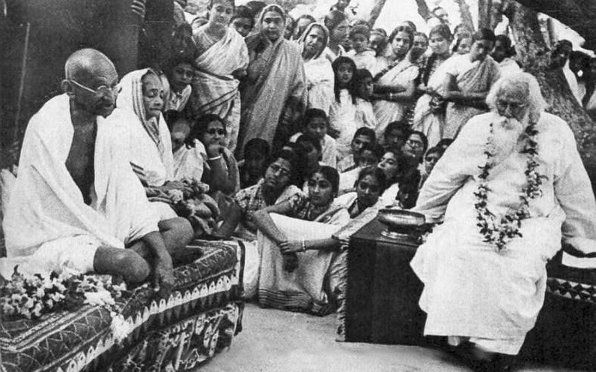
Santiniketan tagore gandhi 1940
This picture of Tagore and Gandhi was taken in 1940 at Santiniketan, India. Santiniketan was the site of a university Tagore had established years before. Tagore died a year after this picture was taken; Gandhi was assassinated in 1948
Rabindranath Tagore Untitled Dancing Girl scaled
Tagore once said of his career as a painter that he was “secretly drawn” to work that came to him “least easily”. Perhaps one of his challenges was the fact that he did not see colors the way most people do. Tagore had difficulty distinguishing reds from greens. Some observers theorize that this color confusion may have explained some of the artist’s dramatic color schemes. However, with a man as complex as Rabindranath Tagore, this explanation likely oversimplifies the creative process. This picture is labeled “Untitled” and is described as being a portrait of a dancing girl. The date of the painting is unknown; it was uploaded from Wikimedia Commons and is in the public domain.
Tagore On Education
Rabindranath_Tagore_with_Mahatma_Gandhi_and_Kasturba_Gandhi_in_Shantiniketan

Rabindranath Tagore was a philosopher, artist, poet, playwright, musician and social reformer.  In 1913, he became the first non-European to be awarded the Nobel Prize in Literature.  Despite this distinction, Tagore never earned a formal academic degree.  When referring to his own education, Tagore spoke about  ‘freedom’,  not ‘discipline’.  He described his childhood home, which inspired his point of view,  as one in which “freedom in the power of our language, freedom of imagination in our  literature.. ” prevailed.  Rote learning and routinized instruction were stifling and counterproductive, in his view.

Tagore believed that education was an organic process in which the individual responded to the environment. Much in his philosophy of education resembled that of another Nobel Laureate, Marie Curie.  Both Nobel Prize winners placed strong emphasis on nature.  Both insisted on the importance of physical exercise.  And both believed that exposure to brilliant minds and brilliant work would elevate, not frustrate, a child. Both were certain that bombarding a child with structured lessons was more likely to kill an appetite for learning than to stimulate it. They believed that acquiring knowledge should be as effortless as acquiring language is for a toddler.

While Rabindranath Tagore and Marie Curie  believed that children should live in a harmonious relationship with nature, Tagore carried the theme of harmony further. He believed it was a function of education to foster harmony between people. He wanted children to be taught arts, especially music, because he thought that would enable them to develop sympathy for others. He thought that education should emphasize the progress of nations and not focus on wars and territorial conquests.

Rabindranath Tagore did not simply aspire to educational ideals: he gave them life. In 1901 he founded a school, Patha Bhavana, which embodied his principles. After he won the Nobel Prize, he invested in his school and expanded it into a university. That campus is now the site of one of the most prestigious universities in India, Visva-Bharati.

Were Rabindranath Tagore’s ideas about education misguided? Many people who work in education today apparently believe so. Increased emphasis on standardized learning and objective testing seems to be proof of that. Schools today are  laboratories in which competing theories of education are tested. As the experiment with today’s children proceeds, so will the dialogue about their future continue.

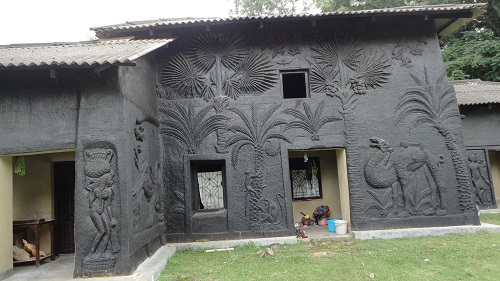
Artistic_mud_house_at_shantiniketan
For more on Rabindranath Tagore visit our page: Rabindranath Tagore
 

******************************************************************

Quotes:

It is still difficult for me to realize that I have no absolute claim to keep up a close relationship with things, merely because I have gathered them together“. From: My Reminiscences, 1917

He (my father) also knew that truth, if strayed from, can be found again, but a forced or blind acceptance of it from the outside effectually bars the way in”. From: My Reminiscences, 1917

“The west seems to take a pride in thinking that it is subduing nature; as if we are living in a hostile world where we have to wrest everything we want from an unwilling and alien arrangement of things.” From : Sadhana : The Realization of Life, 1916