Student Writing Tip #2: Exclamation Marks


frog surprise

Though it is true that even the most information-laden pieces need energy, that energy should come from words, not punctuation.  Just as a human being cannot live well in a perpetual state of excitement, few writing pieces bear up well under a constant stream of commands by the author to be excited or surprised. Readers soon weary of the ubiquitous exclamation so that eventually it loses its power and simply becomes a distraction. Use the exclamation mark sparingly; this handy punctuation tool can assist in adding emphasis, but only if used appropriately.

Weak writing depends on punctuation to convey meaning.  Punctuation enhances and supports a piece; it does not carry the piece.  If you want to show excitement, then show it through description and pacing of narrative.  The following examples demonstrate how that might be done:

Example #1

It was a quiet day.   I walked along the lane and contemplated all the birthdays I’d had in the past.  Some had been fun and  some had not been very enjoyable. However, none of them had been dull.  I began to feel  sorry for myself. Very soon this feeling passed because a group of friends was waiting for me at the end of the lane.  This was going to be a good day after all.

Example #2

I walked home that day, as I did every other.  This was going to be the dullest birthday I’d ever had. No one remembered me.  No one gave me a present or threw me a party.

I refused to cry in public, but tears welled in my eyes and threatened to flow.  I brushed them away so I could see where I was going.

What was that up ahead? Johanna, Bill, Andrew and so many others, waiting for me!  They were laughing, carrying balloons and wearing party hats.  Right in the middle of the park they were throwing a party. I could tell this was going to be the best birthday ever.   

Both example describe the same scene.  The second example is more effective for several reasons. These have to do with punctuation, descriptive language and pacing.

The first paragraph has seven periods and one comma.  The second has many commas and periods.  There is also an exclamation mark and one question mark.  Not only do these various signs give clues to reader about how to read the piece, but they also provide visual interest.

In the first paragraph the narrator tells us about feelings but doesn’t give us any insight into those feelings.  The second example gives details and uses specific descriptive words so the reader can see what the writer imagines.

Now, think of the emotional pace in each example.  In the first example, the emotion is flat. Neither the words nor punctuation provided any energy.  In the second example, however, there is a definite movement in energy.  It begins low and peaks, then subsides again.  The exclamation mark does help to indicate where the piece peaks but it does not do this work alone.  The writer has built to this point and then gently allows the reader settle into a quieter mode again.

Exclamation marks can be very useful, as the use of exclamation shows in the second example.  However, the true power in a piece comes from the writer’s craft, from the use of words that convey emotion and action. Exclamation marks enhance, but do not replace, good writing.

Student Writing Tip: First Paragraphs

fishing

(This piece is excerpted from Rhythm Prism‘s language arts book:  The Artist Inside)

When writing nonfiction, start with a first paragraph that lets readers know what the piece is about. Not only should the first paragraph state your purpose, but the very first sentence should be dynamite. Get your readers’ attention right away so they want to stay with you.

Whether writing fiction or nonfiction, keep in mind that you are communicating. At every point in your piece readers must be persuaded to listen. Address readers in a way that makes them want to continue reading.

When writing fiction, you have more flexibility with your first paragraph than you do with nonfiction. In fiction, you are allowed to mystify the readers. However, you are never allowed to bore them. Mystify them if you will, but make them want to find out more about the mystery.

Whether you are writing fiction or nonfiction, your first paragraph is the bait with which you hook readers. Among writers, the first sentence is often referred to as ‘the hook’. Writing a powerful ‘hook’ is the best way to launch a great piece.

Tagore Gallery and Blog: Featuring Original Work by Tagore and Information About His Esthetic and Life

Pictures of Rabindranath Tagore, his family and matters related to his life will be added to this page gradually.  These pictures are offered for the reader’s enjoyment.  It is hoped that more people in the West will become familiar with the work of this writer, artist, philosopher.

Tagore's_family public domain tag
Rabindranath Tagore posed with his son, his two daughters and his daughter-in-law for this picture in 1909. From the book, Rabindranath Tagore
Tagore with Astronomer Karel Hujer 1935 public domain
Here Tagore is pictured with the astronomer Karel Hujer. Hujer was a Czech who settled in the US after fleeing from the Nazis in the 1930s. An avowed pacifist, Hujer was an admirer of Gandhi and Tagore. In 1949, after both Gandhi and Tagore were deceased, he organized the World Pacifist Meetings in India. The photo was taken in 1935, by an unknown author; it is in the public domain.
Rabindranath_Tagore_Man_and_Woman3
Tagore’s painting, entitled Man and Woman. Tagore started painting after the age of 60. His brief career as a painter is discussed in the book, Rabindranath Tagore.
Einstein_and_Tagore_Berlin_14_July_1930 public domain tag
Tagore and Albert Einstein posed for this picture when they were in Berlin, 1930. From the book, Rabindranath Tagore
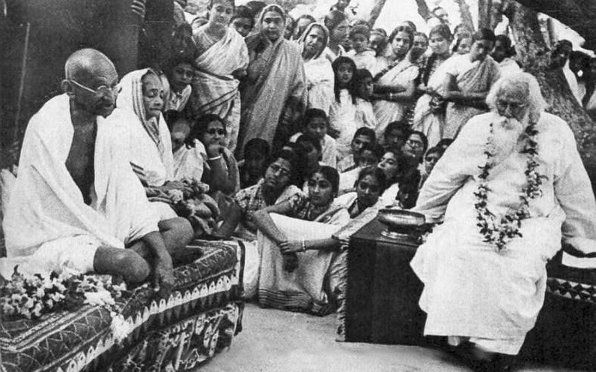
Santiniketan tagore gandhi 1940
This picture of Tagore and Gandhi was taken in 1940 at Santiniketan, India. Santiniketan was the site of a university Tagore had established years before. Tagore died a year after this picture was taken; Gandhi was assassinated in 1948
Rabindranath Tagore Untitled Dancing Girl scaled
Tagore once said of his career as a painter that he was “secretly drawn” to work that came to him “least easily”. Perhaps one of his challenges was the fact that he did not see colors the way most people do. Tagore had difficulty distinguishing reds from greens. Some observers theorize that this color confusion may have explained some of the artist’s dramatic color schemes. However, with a man as complex as Rabindranath Tagore, this explanation likely oversimplifies the creative process. This picture is labeled “Untitled” and is described as being a portrait of a dancing girl. The date of the painting is unknown; it was uploaded from Wikimedia Commons and is in the public domain.
Tagore On Education
Rabindranath_Tagore_with_Mahatma_Gandhi_and_Kasturba_Gandhi_in_Shantiniketan

Rabindranath Tagore was a philosopher, artist, poet, playwright, musician and social reformer.  In 1913, he became the first non-European to be awarded the Nobel Prize in Literature.  Despite this distinction, Tagore never earned a formal academic degree.  When referring to his own education, Tagore spoke about  ‘freedom’,  not ‘discipline’.  He described his childhood home, which inspired his point of view,  as one in which “freedom in the power of our language, freedom of imagination in our  literature.. ” prevailed.  Rote learning and routinized instruction were stifling and counterproductive, in his view.

Tagore believed that education was an organic process in which the individual responded to the environment. Much in his philosophy of education resembled that of another Nobel Laureate, Marie Curie.  Both Nobel Prize winners placed strong emphasis on nature.  Both insisted on the importance of physical exercise.  And both believed that exposure to brilliant minds and brilliant work would elevate, not frustrate, a child. Both were certain that bombarding a child with structured lessons was more likely to kill an appetite for learning than to stimulate it. They believed that acquiring knowledge should be as effortless as acquiring language is for a toddler.

While Rabindranath Tagore and Marie Curie  believed that children should live in a harmonious relationship with nature, Tagore carried the theme of harmony further. He believed it was a function of education to foster harmony between people. He wanted children to be taught arts, especially music, because he thought that would enable them to develop sympathy for others. He thought that education should emphasize the progress of nations and not focus on wars and territorial conquests.

Rabindranath Tagore did not simply aspire to educational ideals: he gave them life. In 1901 he founded a school, Patha Bhavana, which embodied his principles. After he won the Nobel Prize, he invested in his school and expanded it into a university. That campus is now the site of one of the most prestigious universities in India, Visva-Bharati.

Were Rabindranath Tagore’s ideas about education misguided? Many people who work in education today apparently believe so. Increased emphasis on standardized learning and objective testing seems to be proof of that. Schools today are  laboratories in which competing theories of education are tested. As the experiment with today’s children proceeds, so will the dialogue about their future continue.

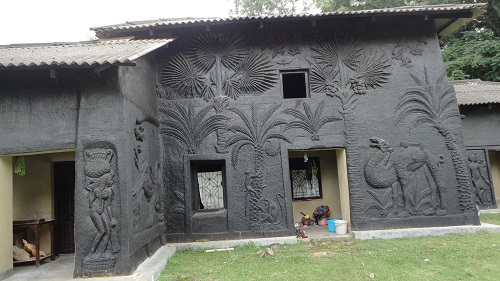
Artistic_mud_house_at_shantiniketan
For more on Rabindranath Tagore visit our page: Rabindranath Tagore
 

******************************************************************

Quotes:

It is still difficult for me to realize that I have no absolute claim to keep up a close relationship with things, merely because I have gathered them together“. From: My Reminiscences, 1917

He (my father) also knew that truth, if strayed from, can be found again, but a forced or blind acceptance of it from the outside effectually bars the way in”. From: My Reminiscences, 1917

“The west seems to take a pride in thinking that it is subduing nature; as if we are living in a hostile world where we have to wrest everything we want from an unwilling and alien arrangement of things.” From : Sadhana : The Realization of Life, 1916