War’s Therapeutic History


Hospital_at_Scutari_reduced2a
Florence Nightingale tending the sick and wounded during the Crimean War. Lithograph E. Walker; Day & Son. Located in the Library of Congress. Copyright expired.

By A. G. Moore

It is ironic that throughout history, war has been an effective laboratory for creating advances in medicine. Human beings are the raw material of war. Injured humans, sick humans, cannot carry out the mission of their masters. They cannot win victories if they perish from wounds, or struggle with illness. It is in the interest of nations and the leaders of nations to protect soldiers. And thus, history shows, war has been the environment in which medical innovation and discovery has often occurred.

Of course, there have been idealists who labored, in war and peace, to improve medical care. No slight is here intended to these heroes. I am in awe of often unacknowledged and anonymous benefactors who give their lives to save the lives of others. But even in these instances, it has often been the case  that the work of the idealist is sponsored and supported by a less altruistic actor.

For example, Florence Nightingale traveled to the Crimea in the midst of a terrible war because she wanted to save lives. No one has ever been able to impugn the motives of this great nurse and medical innovator. Her actions saved not only British soldiers but countless soldiers of all nationalities who fought in successive wars.

As is typical of medical innovation prompted by warfare, Florence Nightingale’s insight and reforms also extended to civilian populations. She began a revolution in sanitation and nursing that has benefited every generation, civilian and military, across the world.

Not only did Florence Nightingale improve nursing and hospital practices, she also inspired a transformation in battlefield ethics. Because of her example and advice, the concept of neutrality for professional medical personnel evolved as a modern concept in warfare. The Geneva Conventions, which cemented this concept in international law, were a legacy of Florence Nightingale’s influence.

However, without the Crimean War, and without the English Crown’s need for healthy soldiers to carry on in battle, Florence Nightingale might never have gone to the Crimea. The English Crown was in crisis because of the appalling number of deaths suffered by its soldiers in the Crimea. This crisis threatened to deny the English a victory in the Crimean War.

Florence Nightingale became an angel to suffering soldiers in the Crimea and a savior to the English war effort. She became a popular figure to families in Britain whose loved ones were saved and she became a national hero because of her contribution to the war effort. Queen Victoria personally awarded Florence a unique medal, The Nightingale Jewel, in commemoration of her extraordinary service.

Medical innovation in wartime did not not begin or end with Florence Nightingale. In the ancient world, Greek, Egyptian and Indian doctors traveled to battlefields to treat the wounded. Improved surgical techniques were the result.

In more modern times, Jonas Salk worked on an influenza vaccine at the behest of the US government during WWII. It was the successful development of a flu vaccine that helped Salk to understand the direction to take in his research on a polio vaccine.

The carnage of war throughout history has been a prompt for development of therapeutic medicine. This is an opportunistic result: the attention and energies of great powers focus on medical care at these critical junctures because of battlefield imperatives. A true advance would be for state leaders to see the urgency of focusing on medical care in peacetime, when the needs of civilian populations are front and center. This would represent not only a revolution in medical science but also a essential evolution in the human condition.
How Radiation Causes Cancer

Ever since the first atomic bombs were detonated in 1945 there has been an ongoing  debate about the  hazards of exposure to radioactive material.  On one side it is argued that any exposure presents a risk to health.  On the other side it is argued that the risk of exposure is exaggerated by an anti-nuclear lobby. However, both sides agree on this point:  at very high doses radioactive material can sicken and even kill.

Below the acute level, the debate usually centers around the link between exposure and cancer. Research on the nature of this link has been a global endeavor since 1945.  In order to interpret the results of the research, a basic understanding of cancer genesis is necessary.

Simply put, cancer is the consequence of abnormal cell reproduction.  Tissue–such as skin, lungs, gut–are comprised of cells, which are themselves made up of molecules. The basic building block of a molecule is the atom.

Ionizing radiation–radioactive energy–damages cells on the atomic level (that is, it damages the atom). What this means is that the very structure of an atom–and therefore of a cell–can be altered when it is exposed to radioactive material.

Routine cell death is essential to healthy tissue. It happens all the time. There are two kinds of cell death: programmed (expected)  and traumatic (unexpected).  In either scenario, dead cells must be cleared from the bloodstream and replaced if an organism is to continue to function well. It is in the replacement of dead cells that the risk of cancer lies.

Replacement is supposed to be an orderly process. The directions for this process are contained in the cell’s DNA. But what if the DNA has been damaged and the directions for replication are garbled?  What if a replicating cell receives the wrong message and doesn’t reproduce properly?  In that event, a cell may form something that is like the original but is in some way ‘strange’.

Let’s take the liver as an example.  Liver cells replace themselves through replication.  If, however, the DNA of the replicating cells is somehow damaged, the new cells don’t come out exactly right.  These ‘strange’ cells may then survive and replicate, creating more imperfect cells, like themselves.  These ‘strange’ cells do not perform the functions of the liver, because they’re not designed to do that. And yet, they  remain in the liver, replicating, forming tissue–‘strange’, invasive tissue. That would be a cancer.

Of course there’s a lot more to cancer than this simple description suggests. But essentially, this outline describes how cancers may begin. Inherent in this process is the potential for metastasis.

In the case of metastasis (cancer has spread to another part of the body) the ‘strange’ cells hitch a ride in the bloodstream and travel to other sites in the body.  There they take root, replicate and once again become invasive. Metastatic liver cells metastasize most commonly in lymph nodes, bones and lungs.

Back to the debate about the link between radioactive material and cancer: Radioactive material interferes with cell replication because it has the ability to change the structure of an atom: it does this through ionization.  Ionization involves stripping electrons from the outer shell of an atom.  When that happens, electrons become free agents. These electrons can travel around doing mischief.  They may link with other electrons and break chemical bonds. This breakage can occur inside DNA, the critical reservoir of information for cell replication.   Damaged DNA will give the wrong instructions to a replicating cell. The consequence of this error may be the production of a cancer cell.

Of course, cancers develop in the absence of ionizing radiation. Cells make mistakes all the time. They reproduce so often that mistakes are inevitable. Sometimes the mistakes, or mutations, benefit an organism. These mutations may be kept because they may enhance the chance that a species will survive.  Sometimes, however, a mutated cell is not cast off and does not benefit an organism. The cell may take root in tissue and begin to propagate right alongside normal cells.

To be sure, the fact that ionizing radiation can cause cancer doesn’t mean it does cause cancer. This link must be proven if it is to be accepted as established fact. The proof, evidence strongly suggests, may be found in experience and data derived from that experience.

Ever since the atomic bombs were detonated over Hiroshima and Nagasaki researchers have been collecting health statistics on survivors of the blasts. About 200,000 of these have been tracked. This is a disparate group: dose levels varied greatly. There were both male and female, young and old victims.   All of the information collected on survivors–dose level, age, gender–was analyzed.  By comparing the health profiles of these individuals with profiles of those who were not exposed to the blasts, scientists believe they’re able to approximate the health risks of exposure to radioactive material.

A few things appear to be certain: there is a link between exposure to ionizing radiation and cancer.  Existence and severity of effects are dose-dependent: those who receive the highest doses are most likely to develop a cancer at some point. Age at the time of exposure is also important. The younger the person at time of exposure, the more likely  that cancer will someday develop. Gender plays a role: women experience more adverse health consequences than men.

Although the discussion in this essay is about the link between cancer and exposure to radioactive material, data from survivor studies reveals that health consequences were not limited to cancer. Among the conditions noted to occur at elevated levels in the survivors are: cardiovascular, digestive, neurological and thyroid diseases.

“Safe” dose guidelines that exist today have been derived from A-Bomb survivor studies.   It is these “guidelines” around which so much of the current debate revolves. This is a debate usually left to ‘experts’.  Perhaps, though, given the stake that everyone has in the establishment of safe guidelines, more of us should get involved in this debate. Perhaps it is time for a little self-education, because everyone is potentially affected by the decisions of the ‘experts’.  This is a conversation in which we should all take part.

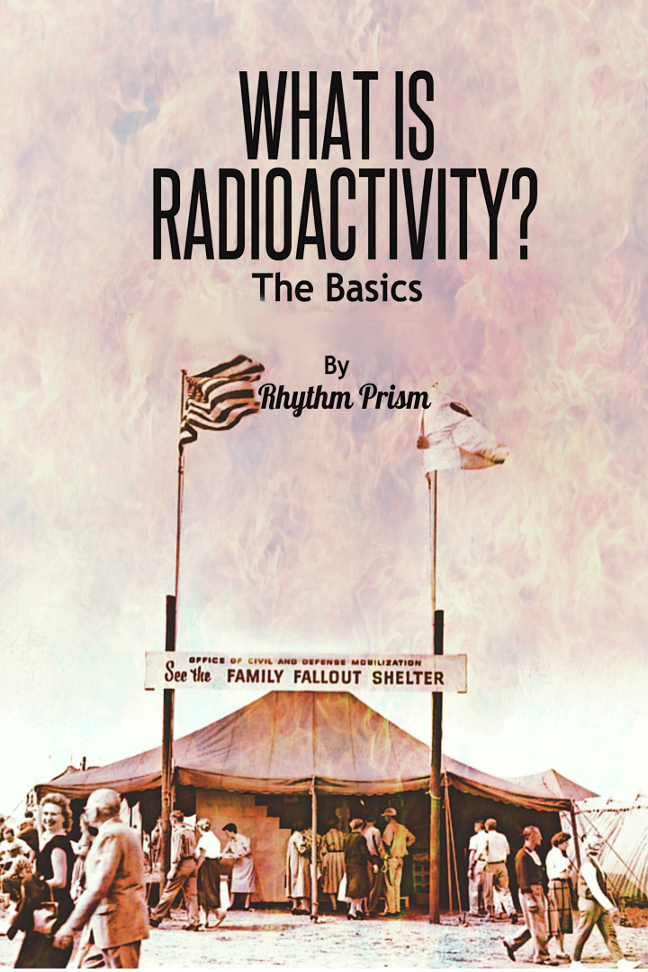
For more information on radioactivity, an easy-to read book::What is Radioactivity?The Basics

what is radioactivity for wordpress

https://rhythmprismpublishing.com/what-is-radioactivity/

Marie Curie: A Life Illuminated by Intelligence, Determination and Courage

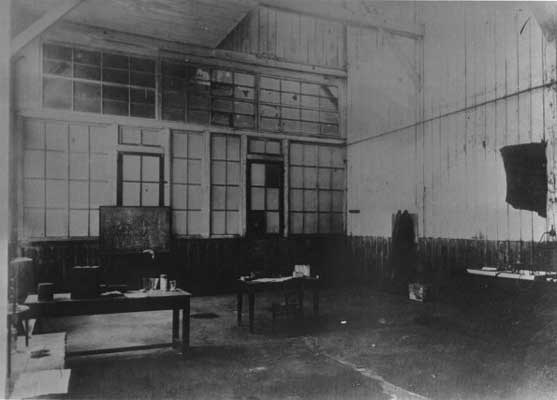
Marie_Curie-Laboratory before 1937 author unknown
A picture of Marie Curie’s laboratory where she did much of her work on radium.

When we read about famous historical figures their accomplishments seem obvious, their acclaim assured. Closer examination often reveals a different story. Marie Curie, for example, almost didn’t get her first Nobel Prize. Even after winning the prize, she and her husband struggled to find appropriate laboratory space in which to conduct their experiments. And, though Marie Curie was the first woman to hold a professorship at the Sorbonne, she was only given that position after her husband’s became vacant because of his death.

Most modern observers marvel at Marie Curie’s intelligence and insight. A review of the obstacles she overcame suggest that perhaps her most influential traits might have been determination and courage. Marie had faith in her own abilities, but stronger than that was a conviction that her work was important.

Albert Einstein once described Marie Curie as someone who was totally indifferent to fame. She was a scientist. She did hard, grinding labor. She extracted radium and polonium from pitchblende; the yield of this extraction was in minute quantities. The exquisitely slow pace of the process did not deter Marie. She endured physical consequences of her effort–radiation burns and fatigue–without complaint.

When World War I broke out, Marie Curie used her scientific knowledge to save lives. She designed portable x-ray units and traveled to the front so she could offer her services to wounded soldiers. Marie Curie did this as she did everything else in her life, with courage, intelligence and a lack of regard for herself.

As we read about Marie Curie, and other accomplished figures in history, we marvel at what they achieved. Often, however, the better part of their story may be the road they traveled to realize their achievements. The strength of character displayed in some cases–certainly in Marie Curie’s case–is certainly as noteworthy as the honors earned.

********************************************************

Two books issued by Rhythm Prism are dedicated to Marie Curie’s life. One, Marie Curie: Radium, Polonium, is designed for a general audience and the other, Marie Curie: Science Pioneer,  addresses the interests of children.  Material in both books overlaps, although specialized information about Polonium and Radium are contained in Marie Curie: Radium, Polonium.

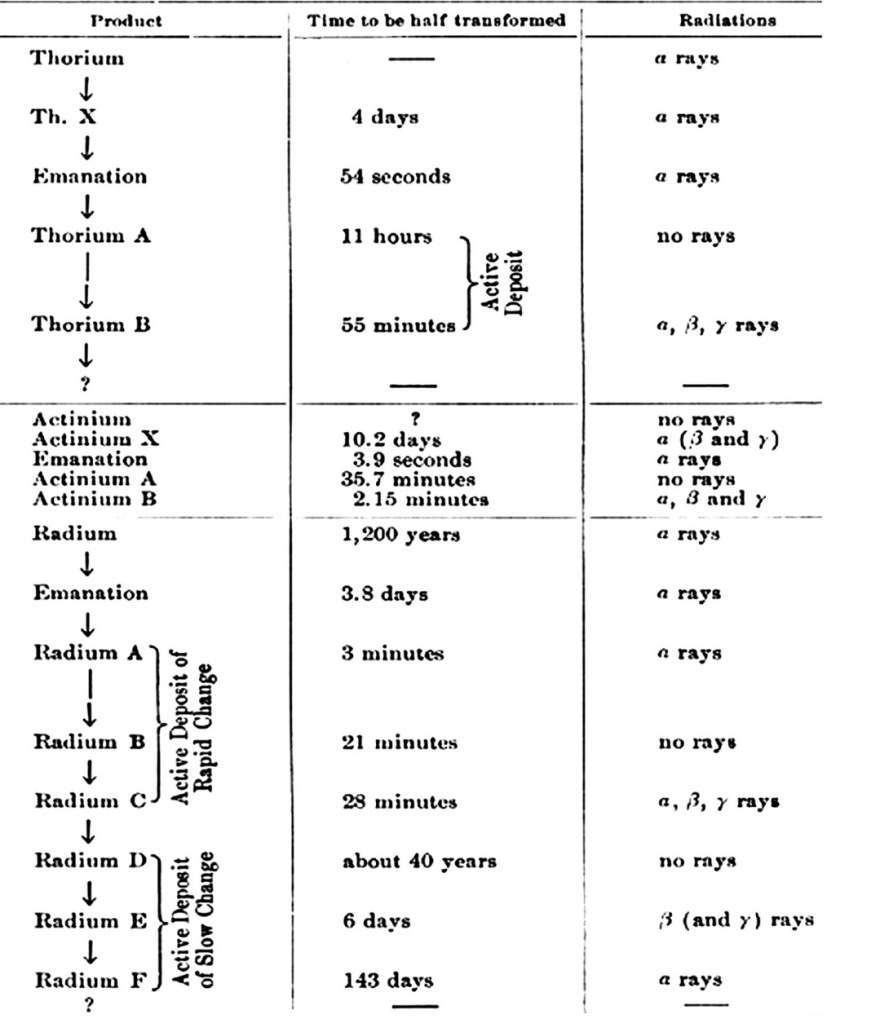
Marie and Pierre Curie discovered two elements on the periodic table, radium and polonium. One of the difficulties they had in working with polonium was the fact that it kept “disappearing”.  What they did not understand at the time was that radioactive elements decay at a regular rate, called its half life.  Below is a chart (which appears in the Rhythm Prism book Marie Curie: Radium, Polonium) that shows the process of thorium decay.  The chart was the work of Ernest Rutherford, who was himself a Nobel Laureate.

thorium chart

Marie Curie: Radium, Polonium and Marie Curie: Pioneer in Science are written in very basic language.  If you’re interested in gaining a rudimentary understanding of radioactivity and learning about Marie Curie, both books will serve that purpose.

General Interest Book

marie and atom 5 cover smash site

Children’s Book (with study guide)

BeFunky_Marie for site

 Another book that introduces more information about radioactivity is the Rhythm Prism publication, What Is Radioactivity? The Basics.  This book is offered in  6 by 9 and  8 1/2 by 11 workbook version. Reading level is adult or mature student.

what is radioactivity front  cover 6 by 9 print site