Who Owns a Child?

What is the boundary between parental rights and state responsibility?  Even avowed libertarians will agree that at some point the state has an obligation to insure a child’s well-being. Difficulty arises in defining how closely the state can monitor that well-being and how the well-being is defined.  These definitions are not fixed.  Ideas about the rights of parents and children evolve.  Often, when the state steps in it does so in the name of the child, or at least that is the rationale given.  When the state fails to step in, it often takes this course out of respect for parental rights.  Unfortunately, both involvement and non-involvement can result in harm to the child.

Even if the discussion about parental rights were confined to the United States, it would quickly become apparent that there’s no universal agreement about where the state’s right to interfere in the home begins and ends.   While federal regulations exist that guide state child protection laws, interpretation of those laws varies from locality to locality.  For  example, the District of Columbia has several criteria for determining appropriate parenting.  One very specific regulation addresses the speed with which a newborn is collected from a hospital. If the child is left for “at least 10 calendar days” despite being medically fit for discharge, then the court might determine parental rights should be terminated.

The State of Georgia explicitly asserts that the preferred placement for a child is in the home:”…each child coming within the jurisdiction of the court shall receive, preferably in his or her own home, the care, guidance, and control that will be conducive to the child’s welfare and the best interests of the State…”

One parental prerogative on which every US state agrees is the right to inflict corporal punishment on children.  This right is exclusively reserved for parents in some states, while others allow corporal punishment to be inflicted by schools also.

Child welfare is something most people think they agree on.  However, ideas about child welfare vary from family to family, community to community.  At some point government steps in and decides when a child’s welfare has been endangered.  Communities decide on the boundary between government responsibility and parental rights.  Once the boundary is determined, a wide range of liberties may be affected.  It is hard to imagine every area where the boundaries might blur.  Certainly government is likely to assert an interest in custodial supervision, medical care and education. How that interest is expressed depends on where a family resides.  A guide to different rules in different states may be found in the publication: Child Welfare Information Gateway.

Many people don’t spend much time thinking about the ways government might intrude into family life. However, conflicts between government policy and family belief is not uncommon. This conflict may arise in families that decide to home school.  It may arise in families that decide not to vaccinate their children, or to forgo medical treatment.

Who owns a child?  All states to one degree or another are committed to protecting the welfare of children. It behooves a parent to understand the laws of the state in which the child resides, because ultimately, government is the final arbiter of where the boundary between parental right and government responsibility falls.
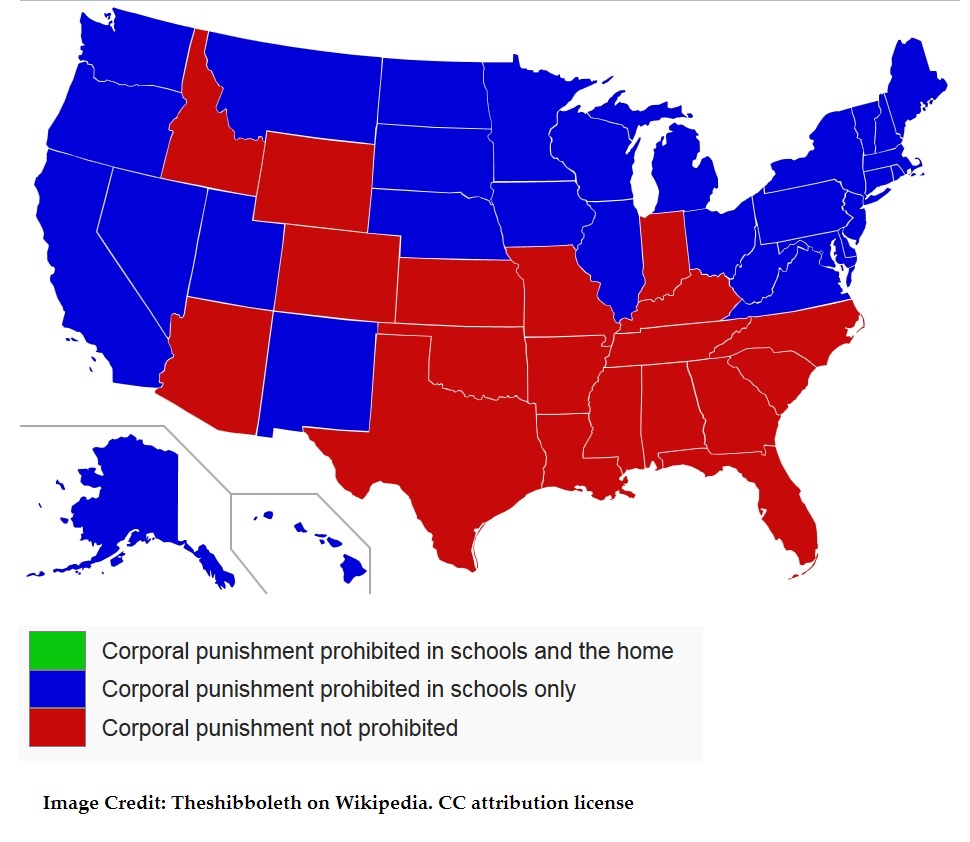
corporal punishment map

Indigenous People of Australia

Truganini
Truganini, reported to be the last full-blooded Palawa from Tasmania. Truganini died in 1876. (Public domain picture, author unknown, copyright expired)

This piece was adapted from The Modern British Empire, Rhythm Prism’s first history book in its Reading for Fun and Comprehension series.

Most recently, the essay was included in Exploration and Conquest: Stories of Indigenous Peoples.  This book is designed for a mature audience.  It includes material on French, Italian, Belgian and Spanish colonialism.  The book tells its stories with the help of pictures. These reveal the experiences of real people who suffered the effects of European colonialism across the globe.

 ♦♦♦

In referring to the indigenous (indigenous means native to, or original) people of a territory, the word aboriginal is often used. The indigenous people of Australia and Tasmania, for example, are usually referred to as Aborigines. This term is convenient but not very accurate. Just as there were different ethnic groups in Europe, so were there different ethnic groups in Australia and Tasmania.

Europeans coming upon the different groups, or tribes, of the new territory did not notice distinctions, only similarities. Among the groups that existed in Australia and Tasmania at the time of conquest are included the following peoples. There were hundreds of groups; these are just a few of them:

*Pitjantjatjara
*Arrernte
*Luritja
*Walpiri
*Ngunnawal
*Awabakal
*Eora
*Kamilaroi
*Muthi Muthi
*Tharawal

It is estimated that before European colonization of Tasmania there were between 3,000 to 15,000 Palawa living there. Britain colonized Tasmania (then called Van Dieman’s Land) in 1803. The British used the island as a penal colony–a place to send prisoners. “Transportation”, as the exiling of prisoners was called, was common practice in England at the time.

Conflict between the British and local Tasmanians grew as settlement proceeded. In the 1820s, conflict became so widespread that it was called The Black War. The Black War has been described as one of the earliest recorded instances of genocide in modern times. Over the years, the Palawa people perished, partly as a result of violence and partly as a result of disease. The last full blooded indigenous Tasmanian,Truganini, died in 1876.


Batman's Treaty
Artist’s impression of Batman’s Treaty, signed in 1835. This is the only known time when Europeans directly negotiated their occupation of lands owned by indigenous peoples in Australia. In this case, the treaty was signed by John Batman and elders of the Wurundjeri people. The treaty was declared invalid two months later by the governor of New South Wales. (Public domain picture, copyright expired, author unknown)

Quality Schools for All

(Adapted from another site; originally published in 2012)

It’s natural to want the best for our children. So, when the New York Times runs articles about school zoning in New York City, I am somewhat sympathetic to parents who insist that their children (and therefore their neighborhoods) be included in the most desirable districts. At the same time, I am aghast at the construct of these arguments. Seemingly absent from the discussion is an awareness that it is intrinsically immoral to splice neighborhoods so that real estate values and social distinctions are reinforced.

An oft-cited rationale for gerrymandered school districts is that the middle class will stay only if its children are allowed to attend “good” public schools. Implicit in this rationale are a number of assumptions: there are not enough good schools in the system to go around; real estate values are directly related to school values; and school zoning gives the middle class some control (through their political agents) over the quality of education available to their children.

I would have little grounds for challenging these arguments if the schools in question were private and the citizens who used the private schools paid taxes into a general fund for public education. But the coveted schools are not private; they are publicly funded. The funds are not derived from neighborhoods; they are derived from city, state and federal governments.

If equity were the principle that governed school attendance, then there would not be a system which locked children into “good” and “bad” districts. Privileged parents would not be able to secure their children quality education by moving into a good district; underprivileged parents would not be forced to send their children into crime-ridden, under-performing schools.

By law, every child is entitled to free public education. The education is free in the sense that no tuition is charged, but it is not truly “free” education. Children are often not free to attend any school, but are strictly confined to a neighborhood school. In a free system, a child would be given school choice (not intended here as a euphemism for charter schools); the free market would prevail. In that case, children would presumably flee from “bad” public schools and swamp “good” public schools.

As it is, passions run high when middle class parents are faced with the prospect of losing a place in a “good” school. What does it say about some schools that parents argue so forcefully to keep their children out? It’s a civic disgrace that such discussions continue, year after year. Generation after generation parents are forced to operate in a system of rationing, with winners and losers.

Why can’t everyone be a winner?

There will always be distinctions of class and money between people. Schools are the one place where society can smooth some of those distinctions, can level the playing field so every child has a chance at a bright future. The current educational system in New York, and many cities, does not advance this goal. As long as the expectations of an elite middle class are subsidized by public funds, social and economic stratification will be reinforced, not mitigated.

The antiquated and iniquitous school districting model should be abolished. Children, and parents, should be allowed to vote with their feet. As cities adjusts to this new dynamic, perhaps the motivation will arise to make all schools “good”, instead of just those few schools that serve the  middle class elite.