Haiti: How Colonial Powers Stole Opportunity

flag-of-indendendent-haiti-1803-1804
Haiti’s first flag, 1803.  Haiti was the first independent nation of Latin America and the Caribbean.

By A. G. Moore

(This is a reblog from a 2011 post that appeared on noplaceforrumors.com.)

It is true that Haiti lies on an earthquake fault and in a tropical storm zone.  From time to time the tiny country  is struck by natural calamity of epic proportions.  This is one of those times. However, it is not Haiti’s geography which has been the nation’s undoing:  it  was greed that did it in, the greed of neighbors and overseers who robbed Haiti of its civic and economic legacy before the nation had a chance to claim its future.

Domingue (the name was changed to Haiti after independence in 1804) was a French colony; sugar and tobacco plantations provided a great income stream to France.  The economy of the island was predicated on slave labor, which was imported in such numbers as to exceed the slave trade in all other territories in the western hemisphere, except Jamaica.  Because of the brutal conditions in which the slaves of Domingue were kept, death rates were very high and there was a constant importation of new captives from Africa.

By the late 1700’s Haiti was not a peaceful place.  Recent African immigrants were not as tractable as second generation slaves might have been and the brutality of the conditions in which the slaves were maintained contributed to the unrest.

By 1791, revolution broke out.  Led by Toussaint Louverture, the goal of the revolution initially was not independence but the abolition of slavery.   Louverture led a successful campaign against the French, but eventually was defeated by treachery.  He ended up in a French prison, where he died of pneumonia in 1803.

Perhaps if Louverture had lived, and been allowed to govern, Haiti might have had a chance.  But that’s not likely.  Because, not only had the arrival of colonialists brought death to the indigenous people (the Tainos) of the island,  not only had these colonialists kept their slaves in such barbarous conditions as to deny the slaves’ very humanity (stories are told of slaves being set upon by dogs; of slaves being boiled in vats of molasses; of slaves being buried alive in ant hills), but the French decided, after Haiti became an independent country, that a debt was owed.  Not by the French to the Haitians, but by the Haitians to the French.

At first, in defiance of this demand from France,  Haiti endured an embargo which denied it the opportunity to benefit from trade of its rich produce.  Eventually, the Haitians submitted and agreed to pay France  to  compensate the former slave owners for the loss of their property.  Haiti was handed a bill and that bill was not cancelled until 1947.  One of the reasons for the prolonged debt service was the conditions of payment.  France insisted that the debt be financed through a French bank, which unilaterally set interest rates and terms.

So much for what France owes to the Haitians.

As to Haiti’s northern neighbor, the U. S.:  from the moment  it became an independent country, Haiti was an irritation to the United States.  For one thing, Haiti presented an example to slaves in the U.S.  that a successful rebellion was possible. Plantation owners in the southern part of the United States were unsettled by this dynamic. Insurrections among U. S slaves, especially in Louisiana, were blamed on the Haitian influence.  U.S.  Assistant Secretary of State Alvey Adee summed it up in 1888 when he called Haiti a “public nuisance at our door”.

The U.S. intervened in Haitian affairs numerous times over the years and U. S. corporations found Haiti a profitable place in which to invest their capital.  By 1915 this investment was so significant that when it appeared to be threatened, Woodrow Wilson, the proponent of “self-determination” for European nations, sent an army into Haiti to secure  U.S. interests.  While the stated aim of the invasion was to neutralize German influence on the Island, subsequent actions of the U. S. government belie this claim.  $500,000 was appropriated from the Haitian National Bank, “for safekeeping”; the U.S. took over all the Customs Houses and ports;  it created a national guard which was an arm of the U.S. government.  Finally, Haitians were prevented from passing a constitution unless that constitution allowed for foreign ownership of property.

So…while it was still saddled with a hundred-year-old debt to France, Haiti found itself straddled by an overlord who extracted essentially whatever profits remained.  Any pretext at self government was denied as the U. S. routinely replaced Haitian leaders who did not endorse U. S. policy.

Haiti never had a chance. If there had been a plan to sabotage its future, to deny it the basic opportunity to rule itself and enjoy the benefits of its own  resources, the plan could not have been more thoroughly realized than it is today.

Besides the ruinous appropriation of Haiti’s revenue,  France and the U.S. were guilty of another at least as injurious a theft:  the theft of governance.  Never in Haiti’s history was it allowed to develop a civic organization which was entirely self-engendered and which acted only in the interests of the Haitian people.  Crop development, land management, trade negotiations:  nothing was left  to the Haitians.  Everything was engineered to profit first France and then the U.S.

Today Haiti is beleaguered by depleted soil, antiquated infrastructure (what remains after the last earthquake), a poorly educated citizenry and an almost total lack of governance. Haiti’s desperate state is not an act of God nor an accident of nature.  It is the result of plunder.   Those who have plundered are responsible.

I don’t know how to fix Haiti.  The amount of money necessary to do that may be more than the U. S. and France think they can afford in this difficult financial climate.  But whatever the endeavor costs, it must be done.  For Haiti is a living legacy of French colonialism and U.S. imperialism.  Like any victim of imprisonment and theft, Haiti has a right to compensation and rehabilitation, no matter the price.

Churchill, A Necessary Leader

By A. G. Moore

Winston_Churchill_in_South_Africa_3
Winston Churchill, 1899, as he made a triumphant appearance after escaping from a Boer prison of war camp.

If there are people marked by history to play large roles in the course of human events, Winston Churchill was surely one of these. It might be said that fate was a constant companion on his remarkable path, but in each instance, when fate offered opportunity it was Churchill who gave the final measure. He was audacious, brilliant and ambitious. His character and experience prepared him ideally for the most important task of his life: to hold the British nation fast when all others had fallen before advancing German forces in WWII.

Winston Churchill’s political career began inauspiciously in 1899 when he ran unsuccessfully for a seat in Parliament. This was not to be his only electoral defeat. Over a career that spanned more than 50 years there were failures and successes. There were missteps and achievements. Some of the qualities that led to the missteps were among those which allowed him to lead steadfastly and dramatically during the grim days of WWII.

Churchill was tempered by war. He was attracted to military action and at times placed himself in the front line of battle when more secure environments were open to him. By the time Churchill had won his first seat in Parliament he’d seen action in the Sudan, the Northern Frontier (in what is today Pakistan) and South Africa. In the last of these campaigns he earned instant international notoriety by negotiating an escape from a Boer prison of war camp after a brief period of captivity (4 weeks). In each of his military engagements, death was a distinct possibility; it was a consequence suffered by many of his companions–but not Churchill.

Throughout his career Churchill’s political decisions were shaped by a mindset that held firm to the idea of British empire and an inclination to favor war over negotiation. Long before WWI, in anticipation of German ambitions, he advocated for the building of a strong navy. He did so, some believe, at the expense of developing a powerful ground capability. His strategy, it is widely suggested, led to a disastrous defeat in the Dardanelles during the first world war.

Just as Churchill did not personally avoid the battlefield, he forcefully argued against those who would appease aggressors. He saw danger in Bolshevism and wanted to take on Stalin long before the Cold War. He was vociferous in criticizing Chamberlain for making concessions to Hitler in 1938 and he argued forcefully for a build-up of Britain’s nuclear capability after WWII.

Churchill’s view of Britain’s colonies more reflected a Victorian colonialism than a 20th century appreciation of self-determination. He fiercely resisted Indian independence and dispatched the Black and Tans to put down Irish republicanism in 1919.

At any point in his long career, if Churchill had faltered and his career had been cut short, there might have been little mention of him in the history books. But fate served the stalwart leader well. After the 1940 fall of France to German forces in WWII, and before the 1941 entry of the US into the war, Churchill marshaled all the instincts that had served him well and not so well in the past. He was poised in that moment to become a man of history, a man of destiny–perhaps flawed in another context but exquisitely prepared to steer the ship of state in a moment when Britain stood alone before the German aggressor.

˜˜˜

If you found this discussion interesting, you might also be interested in one of  Rhythm Prism’s books that deal with colonialism: The Modern British Empire: A Brief History and Exploration and Conquest: Stories of Indigenous Peoples.

The Modern British Empire is appropriate for students who are in middle school or high school.  It contains a study guide that reinforces concepts covered.

Exploration and Conquest is appropriate for all mature readers.  The book  (172 pages) uses pictures to help tell the story of European exploration.  The discussion covers the impact of colonialism on indigenous peoples from four continents and from islands that spread across the wide seas.

exploration-cover-rev-site

cover brit for site

The Great Famine of 1876, India


British rule in India dated from 1757, when the British East India Company, under Lord Clive, defeated the Nawab of Bengal at the Battle of Plassey.  British rule did not end until the Indian Independence Act of 1947 was passed.  In the almost two hundred years between Plassey and the Independence Act, India suffered a series of devastating famines.  While perspectives on the causes of the famines vary, there is little doubt by historians that colonial policy contributed to the enormous loss of life.

India was once called the Jewel in the Crown of the British Empire.  Great riches were extracted from the colony.  Many landed estates were financed by wealth gained from the subcontinent.  Millions of lives may have been the price India paid to produce this profit.

The Famine   

The Famine of 1876  was not the first or last suffered by the Indian people.  Also called the Madras Famine, it occurred essentially in southern and southwestern Indian states.  Most historians blame British colonial policy for contributing to the suffering.  While some observers suggest that famine would have occurred in any event because of natural conditions, there is little doubt that British actions turned the famine into a greater catastrophe than it might otherwise have been.

famine
This picture is cropped from a larger photo taken by Willoughby Wallace Hooper in 1876. The larger photo was not used here because it was even more graphic.

The images of emaciated people in the photo above were recorded during the famine, which lasted approximately from 1876 – 1878.  It is not known whether any of the people in the photo survived.  The 1876 Famine is distinguished from some that came before in that there is an extensive photographic record of the events.


Estimating the total death toll of the famine is difficult.  Some historians say five million perished; others put the number of deceased closer to ten million.  In addition to those who died, millions suffered severe malnourishment, the effects of which likely lingered for the rest of their lives.


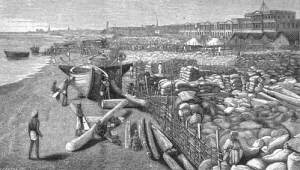
It is believed that long-term and short-term policies of British rule helped to precipitate the famine and to exacerbate its drastic effects.  Grains that could have fed the people were routinely sent out of the country.  Lands that might have grown food for the people locally were converted to plantations dedicated to cash crops.  These crops were sent abroad.


The Viceroy of India at the time of the famine, Lord Edward Lytton, did little to alleviate suffering.  It is overwhelmingly the judgment of history that Lytton’s actions caused the death of millions.  Lytton declined to institute an aggressive relief program.  Not only did he not distribute sufficient foodstuffs to the starving, he also continued to export grains that could have fed them.  At the height of the famine, a record amount of wheat (6.4m hundredweight) was exported to England.


It is certain that Lytton was motivated by a desire to see that India continued to yield a profit for the Crown; however, there was likely a secondary motivation, perhaps as strong.  Lytton was being true to a philosophy called Social Darwinism, which held that in a natural order, the strongest survive and the weakest are winnowed out.  It is this winnowing, Social Darwinists believed,  which is nature’s way of strengthening the population as a whole.  By allowing millions to starve, therefore, Lytton was accommodating a natural process that in the end would be of benefit to society.


After his service in India, Lord Lytton enjoyed a distinguished diplomatic career.  He became Earl of Lytton and Viscount Knebworth.  Among his contemporaries he also enjoyed a solid reputation as a poet.  Upon his death in Paris (1891) he was granted the extraordinary  honor of a state funeral.

grain on the port of Madras
The lithograph by William Digby is based on a photograph by Willoughby Hooper. Digby wrote about the Great Famine in his book, The Famine Campaign in Southern India, 1878. This picture shows grain piling up on a Madras beach as it is readied for export to England.

The material in this essay was modified to match the reading skills of an adult audience. The original essay was written with vocabulary and sentence structure that were less challenging.

Another blog on this site that was adapted from The Modern British Empire: The Massacre at Jallianwala Bagh


………………………………………………………………

While it is true that Britain once was the greatest sea  power on earth and had an empire that stretched across the world, other European nations also had colonies.  In each case, there was evidence of indifference to life and the cultures of indigenous peoples.   The British, for a time, were more successful at conquering and colonizing, but no more brutal.  Italy, for example interned thousands in a Libyan concentration camp and has been charged with using poison gas in its attempt to secure African colonies.  France routinely used conscripted labor in their various colonial enterprises.

The stories of indigenous peoples under European colonialism could fill many books.  A. G. Moore has attempted to tell some of those stories in richly illustrated book (172 pages), Exploration and Conquest: Stories of Indigenous Peoples.   This book can only touch the surface of a complex and tragic history, but it does provide readers with a true impression of the European colonial era and the toll it took on indigenous people around the world.

exploration-cover-rev-site