
Navigating Indieworld: A Beginner’s Guide to Self-Publishing and Marketing Your Paperback (Book Review)

By Carole P. Roman and Julie A. Gerber


sale-real-estate-156502_1280

Most people who write don’t enjoy the business aspect of their work. I know that’s true for me. Unfortunately, once a book is done, it’s simply a journal until it finds an audience. Carole P. Roman’s “Navigating Indieworld: A Beginner’s Guide to Self-Publishing and Marketing Your Paperback” is designed to help writers find that audience.

This book is not a quick read, and if you do read it quickly you’re cheating yourself. I began one afternoon and eagerly went through the pages until I had to stop from sheer exhaustion. There is so much to absorb.

Ms. Roman addresses her book to two kinds of authors: those who are willing to invest money upfront and those who are operating on a shoe-string budget. It seems that the greater reward comes with greater investment, but of course there is also the risk of investing and getting little in return. That’s a calculus each author has to make.

There is an operating principle in Ms. Roman’s recommendations and she readily applies it to herself: “What can I say? I have no shame,” she declares. If you are a newbie author, and self-published, your book is not likely to find its way into readers’ hands unless you’re willing to shamelessly and relentlessly present it to them. Ms. Roman tells us how to do that. She cites names and resources, but the bottom line is, the author has to be willing to do the work.

I fully believe that if writers follow the recommendations put forth in “Navigating Indieworld”, their books will sell. Of course, it all starts with the book, and that is where Ms. Roman begins her recommendations. Before promoting a book, make sure it’s worthwhile. Only trust friends and family to critique your work if they are both savvy and willing to be brutal. And be prepared to take a machete to your art, if necessary, to bring it up to snuff.

Once you’ve got a product worthy of promotion, then go through Ms. Roman’s suggestions. Look up her books on Amazon, if you doubt the reliability of her system. She has managed to publish a successful series of entertaining and educational books. More than this review, use that record as proof that she has mastered both the craft of book writing, and skill of book promotion.

A. G. Moore 11/2016

Maxwell Corydon Wheat, Jr.

max-salt-marsh-cover-site
This thirty-page book will be sold at cost in the United States. 

 From the Introduction

I met Max when he already had achieved a certain notoriety. It was incongruous to me that the peaceful, soft-spoken man I beheld could be the cause of controversy. But it was exactly his peaceful nature that gave rise to offense.

Maxwell Corydon Wheat Jr. was Poet Laureate of Nassau Country, New York. This is the sort of honor that usually attracts little attention, outside the poetry community. But that’s not how things worked in Nassau County.

The County Legislature decided Max was not worthy to be Poet Laureate, because he had written a book about peace in a time of war.

Max’s nomination was rejected. This slight suggested that, not only did the bureaucrats know little about poetry, but they also had a poor understanding of poets.

The poetry community dismissed the dismissal. They crowned their laureate, who had earned his title through acclaim and accomplishment. Hence, Max, a quiet, slight figure with a steady gaze, became the center of controversy.

Max was my teacher. He led a group of Taproot writers. That’s what he called all of us, no matter our skill level: everyone was a poet and everyone was a writer. Over time, this proved true, to varying degrees, for those who persevered under his leadership.

Each voice in the group was given a moment in the spotlight, and each was respected. The only exceptions to this rule were when voices were raised in hatred or anger. Neither of these sentiments survived long in a group led by a man of peace.

Max held his sessions in the fall and spring. When time came to sign up for a session, I’d go down the first day I was allowed. His class was so popular that it might be oversubscribed and I’d be shut out. However, there was little danger of that. Though the door might be officially closed to late entrants, I can’t recall a time when Max turned someone away.

There was, for example, the day a distracted woman wandered into our room. None of us knew her. She was looking for another event and accidentally stumbled upon our class.

A chair was empty, so she sat down. She even joined in the discussion, as I recall. Max didn’t suggest that she was unwelcome, or in the wrong place. When she left, he didn’t chuckle derisively, as some might have been tempted to do. We took our lead from his behavior, as we always did.

That episode captured Max’s strength, and his character. He filled the room with grace, the grace of kindness and generosity. And he had the strength to enforce this environment, by example, and by instruction, when necessary.

I learned to write under Max’s tutelage. Before I entered his class, there was so much I didn’t know. He never let on, as I floundered in those early days. My confidence grew and his lessons took root. It is rare that I write a piece now, and Max’s hand is not on it.

There was a time when I had little patience for poetry. It seemed a self-indulgent art with little objective value. I still don’t write poetry, despite Max’s best efforts, but my ears, my eyes and my heart are open to it.

For the last few years I’ve been writing nonstop–books, blogs, reviews. There is a sense of time running out, but there’s more than that. Max helped me to find my voice and to develop the belief that I can do it, that my effort is valid.

Thank you, Max, for everything. You were an artist, a peacemaker and a teacher. You are missed.

Why Are You a Writer?

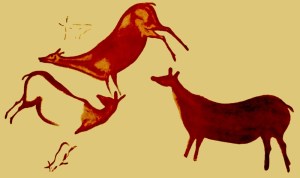
cave art La_Pasiega-Galeria_A-Ciervas_(panel_22)
Cave art from La Pasiega, in Cantabria, Spain; Author: Hugo Obermaier, 1913. This work is in the public domain.


The human effort to leave a record may be seen in cave art dating back 40,000 years.  What prompted these impulses?  Were early humans teaching a lesson?  Leaving a message?  Were they expressing devotion to a deity or satisfying an inchoate desire for self-fulfillment?  Unknowable as the answers to these questions are, so too, for many of us, is the answer to the question, “Why are you a writer?”

Writing is certainly not the most dependable way to earn money.  And it is a career that carries with it the risk of severe, personal criticism.  So, why write?

I have been writing since I was a child.  For me, writing is a way to communicate.  There are other paths to communication–music, art and dance, for example.  Sadly these avenues are not open to me.  Though I express myself with joy through many art forms, I don’t communicate well through them.  They remain my private pleasures.  Words, however, are malleable in my hands.  I mold them, sometimes nimbly, until they convey my intentions in a way that others can understand.  That’s communication.  That’s why I write.

Was I born a writer?  There’s a school of thought that holds some people are born artists and some are not.  I’ve never subscribed to this view.  Give children crayons and they color.  Read nursery rhymes to them and they respond to the cadence of words.  Creativity and art, I believe, are intrinsic to human nature.  Talents vary, as do life influences and opportunity.  The role each of these played in my choice to write–that is impossible to sort out.

I’m a writer.  I’m comfortable in the role and believe I understand the reasons for my choice.

Why are you a writer?