The Can’t-idates: Running For President When Nobody Knows Your Name, Book Review

electoral college map.jpg

By Craig Tomashoff

New York voters might recognize the name Jimmy McMillan. If they don’t, they probably will recognize his trademark slogan, The Rent Is Too Damn High. The personalities featured in Craig Tomashoff’s book, The Can’t-idates, would probably consider themselves fortunate if they managed to achieve anything close to Mr. McMillan’s fame. This is true, despite the fact that each of Mr. Tomashoff’s Can’t-idates aspires to the highest office in the United States, the presidency.

Why has Mr. Tomashoff devoted so much attention to such improbable characters? Why did this author journey across the United States to learn about long-shot aspirants, and why did he think their quixotic efforts warranted a book? Mr. Tomashoff offers an answer to these questions. “We’d probably all be a bit better off,” he suggests, “occasionally stepping outside ordinary expectations, despite the inevitable mocking we’re destined to endure.”

For those of us who live in New York, this explanation may ring true as we recall the several campaigns of Jimmy McMillan. Most of us smiled when Mr. McMillan gave interviews. We cheered when he went toe-to-toe with Andrew Cuomo (New York’s governor) on the debate stage. We didn’t cheer so much for Mr. McMillan’s success as much as we did for his bravado, his brash individuality. We live in a country that lauds individualism. Our national icons, those common historical reference points, are people who defied authority and convention: pioneers, even revolutionaries. These determined non-conformists didn’t bow to authority, they rose up in protest. They defied the status quo (otherwise we’d be living under the Union Jack).

Today, those of us who live in the United States may be spoiled and soft, but we were raised on stories that heralded independent action. And so we applaud the Jimmy McMillans, and the Can’t-idates, even as we smile at their folly. Most of us settle for a lean version of democracy. We do our bit by voting. Not Jimmy McMillan. Not the Can’t-idates. These outliers embrace a robust democracy. They want to be intrinsic to the process. In a way, they are the ultimate democrats, the apotheosis (no matter how humbly cast) of the American ideal.

The Can’t-idates is not a brilliant book, but it is well written. Mr. Tomashoff has come up with an interesting concept, one he manages to make entertaining and relevant. It takes an insightful intellect to see value in a subject that so many lightly dismiss. This book deserves attention. It is a good read and a worthy effort. I recommend Craig Tomashoff’s The Can’t-idates.
The Red Petticoat: A Collection of Poems

chidren-of-lir-ler_swans_millar-2
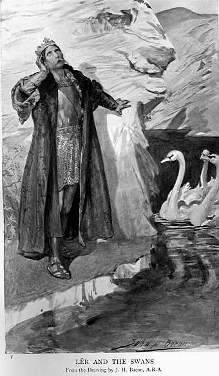
This illustration is from a 1905 book of Irish legends, Celtic Myth and Legend, by Charles Squire.

By Joan Slowey

People sometimes ask what the difference between prose and poetry is. Certainly the lines between these two forms have blurred in modern times, but generally a reader expects prose to have literal significance and poetry to have an emotional component. It would be good to keep this distinction in mind as you read Joan Slowey’s The Red Petticoat.

Joan Slowey’s poetry is personal and yet it has the kind of emotional resonance that echos in the ear and the heart of the reader. Ms. Slowey draws upon her experience. The tone of her work tends to be reflective as she looks back over a lifetime of joy, love, and loss. She uses language that has significance for her, that draws upon her Irish roots. Gaelic words pepper her writing, as do characters from Irish lore. At one point she writes an entire haiku in Gaelic. This is her heart and her psyche speaking, of her tradition and to her tradition. All of it works.

Ms. Slowey covers a variety of subjects. In each case there is evidence of a mature intelligence and a deep empathy. Ms. Slowey has witnessed the full cycle of life and is coming to terms with her place in that cycle. In Minus One, for example, she mourns the passing of her “own particular Adam.” Her “magic circle” has been broken and she wonders

insert-slowey

Two of my favorite poems draw upon her insight as a sentient observer.  One haiku, for example, notes the slime of a snail on her patio and ends with the line, “Well, snails must live too”.   Another, more thought-provoking piece contemplates a creature even more despised than the snail: a flasher.  In this poem, entitled, The Flasher, she lends complexity to a subject most of us dismiss out of hand.  What is the dark secret behind such a low act?  She wonders, as the poem draws to an end,

‘Did he shake with wicked glee?” or did he “Turn away to hide?”

The Red Petticoat is a slim volume. Its brevity invites a leisurely read, and perhaps a re-read.  If you indulge in this temptation you’re bound to find a gem, one poem that resonates with you as so many in this collection did with me.

I highly recommend Joan Slowey’s The Red Petticoat.


A. G. Moore 9/2016


Exploration and Conquest: Stories of Indigenous Peoples

exploration-matebele-cover

This post is adapted from the Introduction to the book.

Cave dwellers told their stories with vivid imagery. Through lively scenes, artists reached across ages and revealed themselves.  This was history, the story of people, of what they did and of what happened to them.

Exploration and Conquest: Stories of Indigenous Peoples is like a cave painting. It tells about people and what happened to them. The book, like the paintings, is rich in imagery. These images help readers to visualize events they have not personally witnessed.

Almost two centuries are covered in Exploration and Conquest: Stories of Indigenous Peoples. The book does not offer a detailed explanation and description of European Colonialism. What it does offer is an impression of how colonization of Asia, Africa, Australia and the Americas altered the destinies of millions of people. 

Exploration and Conquest takes the reader around the world. This is a fascinating and often tragic journey, a brief but riveting chapter in the continuing saga of humankind.

Below is one story out of many that are told in the book:

The French Keep a Foothold in Pondicherry, India

pondicherry-colonials-3-_1890
Albumen photograph by Bourne & Shepherd Studio, Calcutta, 1890, Copyright expired


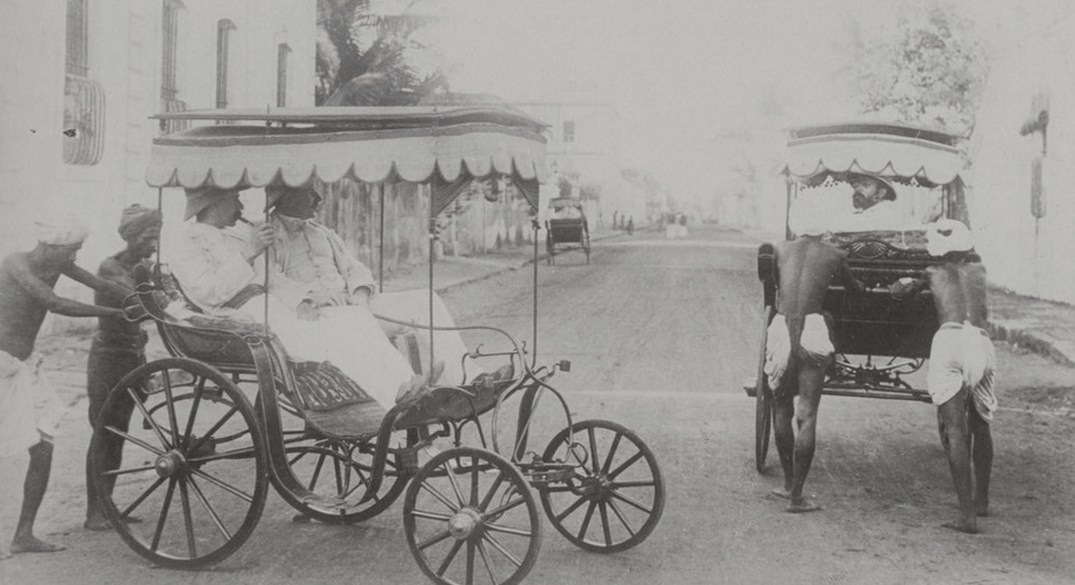
While the British controlled India, the French still maintained a presence there. Called French India, the colony consisted of five small territories spread along two coasts. The largest of these was Pondicherry (today called Puducherry), on the Indian Ocean. The picture above shows French colonials as they navigate the city in carriages that use the energy of local residents, Indians, to propel them.

The French presence in Pondicherry dated back to 1672, when an agent of the French East India Company, M. Martin, bought a piece of land from the King of Bejapoor.  Martin promptly built a factory.  After that, Pondicherry was taken by the Dutch, retaken by the French, taken by the British a couple of times, and then returned to French control, where it remained until 1954.

The town was designed with a canal running down the middle. One side, called White Town, was reserved for the French and the other side, called Black Town, was reserved for Indians.

A. G. Moore   9/2016