Bismark: A Life Book Review


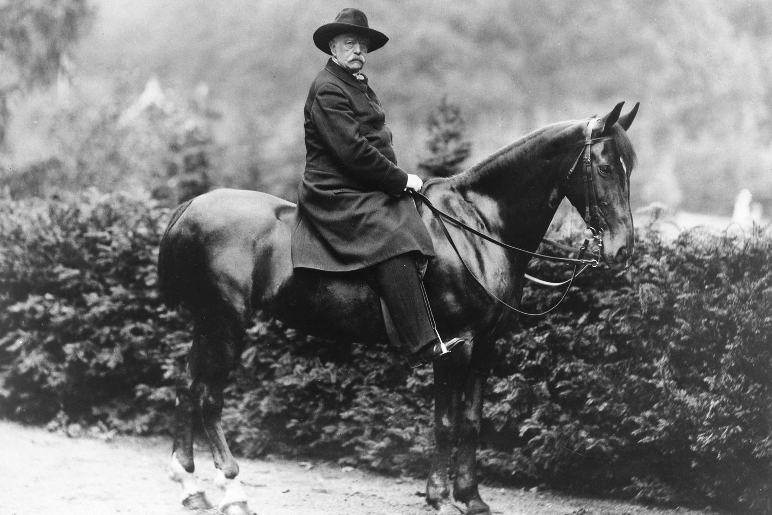
BismarckPferd
Otto von Bismark  July 1890


In Bismark: A Life, Jonathan Steinberg suggests that the modern German state had its origins in the imagination of Prince Otto von Bismark. However, Steinberg builds his case with such apparent animus toward the subject that the value of this book is somewhat undermined.  Steinberg implicitly lays at Bismark’s door responsibility for WWI (by creating the German Empire and buttressing autocracy), WWII (by reinforcing the Junker class and doubling down on militarism), and genocide of the Jewish people (by fueling antisemitism).

Steinberg’s approach is comprehensive. He traces Bismark’s rise to power and attempts to lay bare the state-builder’s multiple motivations. In support of his analysis, Steinberg provides extended excerpts from Bismark’s correspondence and from other first-person accounts. The portrait of Bismark that emerges is more demonic than Machiavellian.

Bismark, by Steinberg’s account, was a hypochondriacal, reactionary, anti-Semite, an ingrate with an unbridled thirst for power. Despite Steinberg’s compilation of evidence, the reader is left with doubts about the integrity of this author’s presentation. His loathing for Bismark is so manifest that we feel bias must inevitably influence judgment.

However, because Steinberg’s book is well resourced, it has much to offer. I was interested, for example, to learn how Germany reacted to the revolutions of 1848. Also interesting was the tension between the papacy and secular heads of Europe. Most fascinating was Bismark’s effort to weaken a rival, France, by aligning himself with Russia. I wondered, as I read, if there was a corollary with present times–with Donald Trump’s expressed criticism of NATO and his avowed admiration for Russia.

I recommend this book, but with reservations.  For a complete view of Bismark, it would be a good idea to read a second biography.  Many questions, in my mind, remained at the book’s end.  Chief among these was, what was Bismark really like?

A. G. Moore     June 2017


The Rise of Prince: 1958-1988 Book Review

An icon, by its nature, is symbolic. Herein lies the difficulty for creatures of flesh and blood who are declared icons. This is an impossible standard to meet, and yet it is one we set for public figures on a regular basis. Just as regularly, they disappoint. As I read The Rise of Prince: 1958-1988 I became aware of the gap between image and reality. This gap exists not because of anything Prince failed to do. It exists because of an ideal I created, an ideal that was important to me. Therein lies the peril of reading the biography of someone we idealize.

The Rise of Prince: 1958-1988, is a responsibly-researched and well-written book. It offers an impressive amount of information about musicology and the music industry. The book’s authors, Alex Hahn and Laura Tiebert, delve deeply into the background and early life of Prince. They do so without engaging in pop psychology. Whatever conclusions may be drawn about Prince’s psyche, the authors leave that work to the reader. This is appropriate.

Any disappointment readers might feel about this book will likely come from the fact that it does not bring Prince’s biography up to the present. Of course, the authors don’t promise to do that. Even so, as the book concluded I wanted to read beyond, to understand how Prince ended up overdosing in the elevator of his home. The Rise of Prince: 1988-2016 would therefore be welcome.

The Rise of Prince: 1958-1988 does not induce snap judgments about the performer’s personality. The narrative crafted by Hahn and Tiebert is too textured for that. One unavoidable conclusion, though, is that Prince did not form enduring bonds with associates. He guarded his prominence in the music world and in public. Those colleagues who distracted, even innocently, from his star stature, did not remain in his close circle.

Prince was a natural-born artist, the son of two performers. His talent was noted in early childhood and his unique skills recognized throughout his career. The most surprising part of this biography for me was that ambition for commercial success was a prime motivator in his life.

Whatever mix of natural talent, inspiration and ambition led to his output, Prince had an undeniable influence on the music of his time, and on musicians who came after. He was a human being, and a legend. The difficulty of reconciling these two realities becomes clear in The Rise of Prince: 1958-1988. The authors’ relative success in achieving this reconciliation makes the book a worthwhile read.

May/2017

A Burial

swamp website 2018 children fixed2
Swamp: an illustration from my upcoming memoir, Arrows Axes and Scythes

By A. G. Moore

This selection is adapted from my upcoming memoir, Arrows Axes and Scythes.

Burial

The move from Krumer’s to Lockwood’s necessitated many adjustments, some positive and some less so. The increased privacy and space were balanced by a cessation of food deliveries. The problem of decreased food supply was exacerbated by an increase in the number of mouths to feed: We began to accumulate pets. Eventually, the number grew to nine. Our pet/food imbalance became a crisis as the animals starved.

I can state with certainty that my mother asked for none of the animals. She didn’t particularly enjoy having pets, but was a compassionate person. Once a pet had been remitted to her custody, she cared for it. The animals sensed this, and they loved her.

Our pets were a hodgepodge of pedigree and mutt. Some were strays and some were delivered to our door in a misguided attempt to give the pets a home. One of these charges was contributed by my father. He found a huge animal, a St. Bernard/Great Dane mix, rummaging in the garbage behind a restaurant. This “rescued” animal, Boots, became a beloved member of the family.

Another dog was brought to the home by my mother’s brother, Jimmy. Uncle Jimmy was important to the family because he owned three dry cleaning stores in Brooklyn. He regularly gave us abandoned clothes, in excellent condition. These were the core of our school wardrobe. Uncle Jimmy’s Chihuahua, Chico, was no longer welcome in his home. That’s how we got Chico.

With nine dogs in the home, and no regular food supply, my mother tried to manage. Potatoes, delivered by my uncles, were cooked and mashed for human consumption. Peels were for the dogs.

Because hunger was their perpetual companion, the dogs took measures. They foraged in neighbors’ trash. Complaints poured in, but my mother couldn’t control the animals and she couldn’t feed them. So the neighbors, or at least one of them, took their own measures. They poisoned the dogs.

Dogs began to turn up dead. They came home to die. We discovered them in various stages of decay. It was Clinton’s job to bury the deceased, but since this was a family tragedy, everybody pitched in.

With the earth frozen, burial was a particular challenge. Clinton’s solution? A bog, a quicksand pool, he found in the forest. In the picture below, the scene of a burial is depicted, as I recall it. This memory is clear.

We dragged our dog, Hortense, up to the bog. Clinton threw her, as respectfully as he could, onto the mud and we waited for her to disappear. In a very little while the surface was smooth again and Hortense was no more.