Churchill, A Necessary Leader

By A. G. Moore

Winston_Churchill_in_South_Africa_3
Winston Churchill, 1899, as he made a triumphant appearance after escaping from a Boer prison of war camp.

If there are people marked by history to play large roles in the course of human events, Winston Churchill was surely one of these. It might be said that fate was a constant companion on his remarkable path, but in each instance, when fate offered opportunity it was Churchill who gave the final measure. He was audacious, brilliant and ambitious. His character and experience prepared him ideally for the most important task of his life: to hold the British nation fast when all others had fallen before advancing German forces in WWII.

Winston Churchill’s political career began inauspiciously in 1899 when he ran unsuccessfully for a seat in Parliament. This was not to be his only electoral defeat. Over a career that spanned more than 50 years there were failures and successes. There were missteps and achievements. Some of the qualities that led to the missteps were among those which allowed him to lead steadfastly and dramatically during the grim days of WWII.

Churchill was tempered by war. He was attracted to military action and at times placed himself in the front line of battle when more secure environments were open to him. By the time Churchill had won his first seat in Parliament he’d seen action in the Sudan, the Northern Frontier (in what is today Pakistan) and South Africa. In the last of these campaigns he earned instant international notoriety by negotiating an escape from a Boer prison of war camp after a brief period of captivity (4 weeks). In each of his military engagements, death was a distinct possibility; it was a consequence suffered by many of his companions–but not Churchill.

Throughout his career Churchill’s political decisions were shaped by a mindset that held firm to the idea of British empire and an inclination to favor war over negotiation. Long before WWI, in anticipation of German ambitions, he advocated for the building of a strong navy. He did so, some believe, at the expense of developing a powerful ground capability. His strategy, it is widely suggested, led to a disastrous defeat in the Dardanelles during the first world war.

Just as Churchill did not personally avoid the battlefield, he forcefully argued against those who would appease aggressors. He saw danger in Bolshevism and wanted to take on Stalin long before the Cold War. He was vociferous in criticizing Chamberlain for making concessions to Hitler in 1938 and he argued forcefully for a build-up of Britain’s nuclear capability after WWII.

Churchill’s view of Britain’s colonies more reflected a Victorian colonialism than a 20th century appreciation of self-determination. He fiercely resisted Indian independence and dispatched the Black and Tans to put down Irish republicanism in 1919.

At any point in his long career, if Churchill had faltered and his career had been cut short, there might have been little mention of him in the history books. But fate served the stalwart leader well. After the 1940 fall of France to German forces in WWII, and before the 1941 entry of the US into the war, Churchill marshaled all the instincts that had served him well and not so well in the past. He was poised in that moment to become a man of history, a man of destiny–perhaps flawed in another context but exquisitely prepared to steer the ship of state in a moment when Britain stood alone before the German aggressor.

˜˜˜

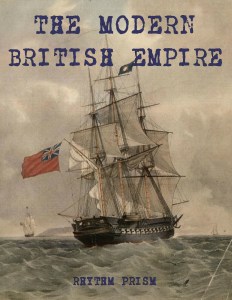
If you found this discussion interesting, you might also be interested in one of  Rhythm Prism’s books that deal with colonialism: The Modern British Empire: A Brief History and Exploration and Conquest: Stories of Indigenous Peoples.

The Modern British Empire is appropriate for students who are in middle school or high school.  It contains a study guide that reinforces concepts covered.

Exploration and Conquest is appropriate for all mature readers.  The book  (172 pages) uses pictures to help tell the story of European exploration.  The discussion covers the impact of colonialism on indigenous peoples from four continents and from islands that spread across the wide seas.

exploration-cover-rev-site

cover brit for site

Looking Back, Looking Forward

Matteawan Station_132

In the book, Looking Back, Looking Forward, the author speaks of leaving her country home and moving to New York City.  The train station above was likely one that was the departing point for her new life; it was likely the last place she saw as headed into the future.

Looking Back, Looking Forward  was written as a demonstration book, not as a straightforward memoir, but the details in the book are all true–at least as true as memory will allow. The author of the book speaks of a kind of longing for the country home left behind. This rupture in her life took place when she was a child and had little control over her destiny.

It is obvious from the events described in the book that the author’s family left their country home for good reason.  Nonetheless, this departure was experienced as a loss and the loss is palpable throughout the book.

The picture of the train station above captures the sense of quiet solitude the author seems to miss. There is in this scene nothing of the bustle she describes of her new home in Brooklyn.

looking back cover for site
This slim volume was created as a demonstration book for the writing manual, “Ten Steps to Writing Your Memoir”. Though “Looking Back Looking Forward” was not intended to be a full-blown memoir, it has within it the inescapable emotions that recollecting any life may evoke.

Marie Curie on Education

Theories about education don’t evolve; they erupt.  Most people understand that childhood offers an irreplaceable opportunity to influence minds for a lifetime.   Maybe that explains the furor surrounding the roll-out of the Common Core in communities across the US. While the trend toward rigid standards, uniform curriculum and increased formal instruction seems sound to some, to others it seems a travesty, a squandering of childhood’s most precious gifts:  play, imagination and exploration. Included in this camp would surely be Marie Curie, if she were alive today to express a view.

In a book she wrote about her mother, Marie Curie’s youngest daughter, Eve, described Marie’s views on education.  Eve explained that Marie dreaded sending her children into the sterile, confined atmosphere of a structured classroom.  Marie regarded formal schooling as  “hours of attendance”.  Her philosophy was that children should be encouraged to find their talent through exploration.  It was in this way that Irene, the older daughter, discovered an early interest in mathematics; and Eve, the younger daughter, learned through experimentation that she was fascinated with music.

Essential to the daily regimen of both Curie children was vigorous physical activity.  Marie installed gym equipment at home and took the girls on camping trips. Together the family trekked through the countryside on extensive biking trips.  “Formal” instruction was put off as long as possible.  In its place, Marie devised a scheme with her  colleagues at the Sorbonne.

The girls, and several other children, would be exposed to the finest minds, in a congenial atmosphere.  Each day the children would spend hours with a professor from a specific discipline.  The weeks would be passed in this way, with a casual rotation between specialties and a cheerful approach toward learning.

Eventually Marie’s daughters were obliged to go to formal classes, but not until this was absolutely necessary.  Irene eventually earned a Doctor of Science degree and Eve earned two bachelor degrees, one in philosophy and one in music.

Irene went on to win a Nobel Prize in 1935 and later continued to do groundbreaking research in nuclear physics.  Eve was for a time a concert pianist. She was also a journalist, diplomat and humanitarian.

Irene died in 1956, Eve in 2007. I would be hard to imagine two more accomplished women.  Whether their mother’s approach to education enabled a lifetime of accomplishment, it would be hard to say.  But their lives and achievements certainly make a good argument for those who believe that a a rigid curriculum may not be the path to a great mind.