The Irish Brigade: Book Review

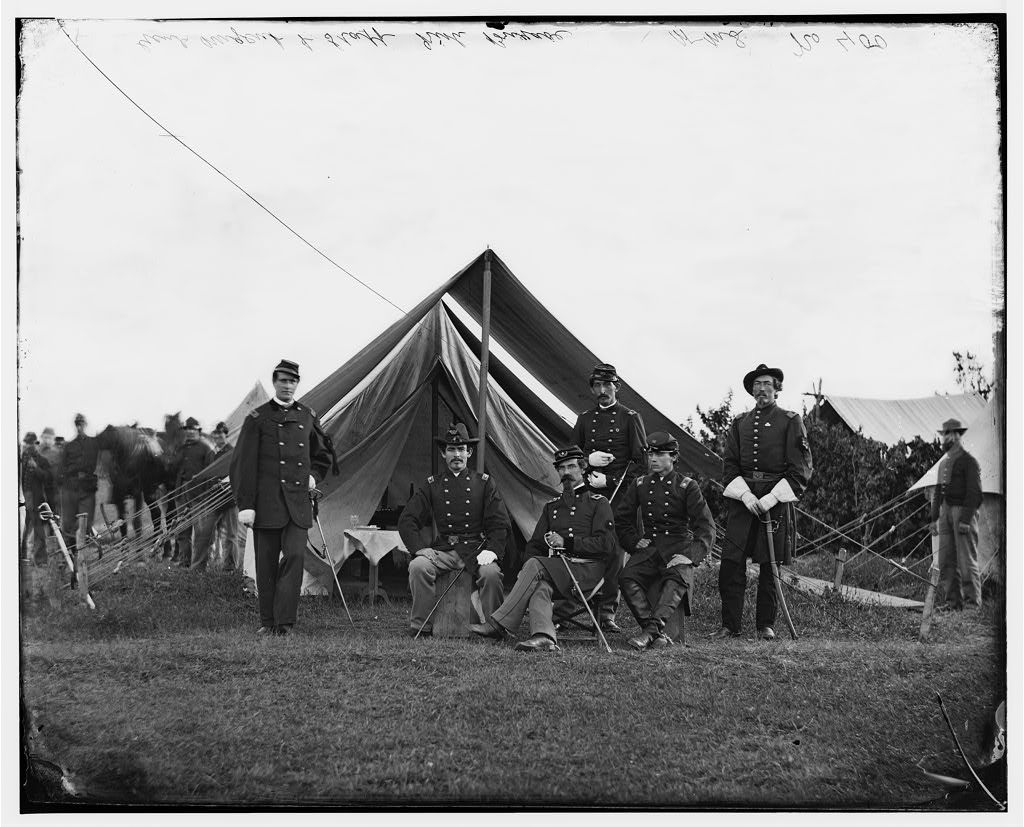
irish brigade Gen._Robert_Nugent_and_his_staff,_Irish_Brigade,_Washington,_D.C._(vicinity)
Brigadier General Robert Nugent poses with the Irish Brigade in Washington, D.C.   1865


“The Irish Brigade”, by Steven J. Wright, is a slim volume that packs an emotional wallop far out of proportion to its size. In a mere sixty pages, the book offers vivid photos and moving descriptions of the Irish who fought in the United States Civil War. There is no shortage of heroism or honor on display in this book. But just as these traits are heralded, so is the tragedy of war driven home.

Most of the people featured in the book did not survive the War. This is a startling reality. Letters to family from fallen soldiers highlight the toll war took on millions from both the North and the South. Although some Irish did join the Confederate effort, overwhelmingly, these men fought with the Union army.

Though sourcing in this book is necessarily selective, because of its size, the material cited is very affecting. A wealth of first-person accounts captures the experience of war.

I found the book in a local library. It is listed for sale in most places as a collectible or rare book. The book would be of particular interest to Civil War buffs or to those who would like to learn about Irish-American history.  I highly recommend Steven J. Wright’s “The Irish Brigade”.

A. G. Moore  June, 2017

The Rise of Prince: 1958-1988 Book Review

An icon, by its nature, is symbolic. Herein lies the difficulty for creatures of flesh and blood who are declared icons. This is an impossible standard to meet, and yet it is one we set for public figures on a regular basis. Just as regularly, they disappoint. As I read The Rise of Prince: 1958-1988 I became aware of the gap between image and reality. This gap exists not because of anything Prince failed to do. It exists because of an ideal I created, an ideal that was important to me. Therein lies the peril of reading the biography of someone we idealize.

The Rise of Prince: 1958-1988, is a responsibly-researched and well-written book. It offers an impressive amount of information about musicology and the music industry. The book’s authors, Alex Hahn and Laura Tiebert, delve deeply into the background and early life of Prince. They do so without engaging in pop psychology. Whatever conclusions may be drawn about Prince’s psyche, the authors leave that work to the reader. This is appropriate.

Any disappointment readers might feel about this book will likely come from the fact that it does not bring Prince’s biography up to the present. Of course, the authors don’t promise to do that. Even so, as the book concluded I wanted to read beyond, to understand how Prince ended up overdosing in the elevator of his home. The Rise of Prince: 1988-2016 would therefore be welcome.

The Rise of Prince: 1958-1988 does not induce snap judgments about the performer’s personality. The narrative crafted by Hahn and Tiebert is too textured for that. One unavoidable conclusion, though, is that Prince did not form enduring bonds with associates. He guarded his prominence in the music world and in public. Those colleagues who distracted, even innocently, from his star stature, did not remain in his close circle.

Prince was a natural-born artist, the son of two performers. His talent was noted in early childhood and his unique skills recognized throughout his career. The most surprising part of this biography for me was that ambition for commercial success was a prime motivator in his life.

Whatever mix of natural talent, inspiration and ambition led to his output, Prince had an undeniable influence on the music of his time, and on musicians who came after. He was a human being, and a legend. The difficulty of reconciling these two realities becomes clear in The Rise of Prince: 1958-1988. The authors’ relative success in achieving this reconciliation makes the book a worthwhile read.

May/2017

Culture vs. Copyright: A Diary of a Naive Philosopher, Book Review

By Anatoly Volynets

 The_Stationers'_Company_Mark
This was the mark of the Stationer’s Company,
which had a monopoly on printing rights in England from
1557 to 1710.  The image is in the public domain.
……………………………………………………

Innovators often have a hard time convincing people to change the way things “have always been done”. History offers startling examples of how tightly people hold onto entrenched views. In the 1950’s, for example, early models of the kidney dialysis machine were considered “abominations” by some doctors at Mt. Sinai Hospital. And in the nineteenth century, Ignaz Semmelweiss was derided by medical colleagues for suggesting doctors should wash their hands before assisting at childbirth. So prepare yourself to resist the notions of Anatoly Volynets when you read his book, Culture vs. Copyright. In the book, Mr. Volynets suggests that artists, and the public, would benefit if copyright laws were eliminated.

Many readers may feel this discussion has little to do with them. They’re probably wrong. Just about anyone who engages in commerce or communication is affected by copyright laws. Posting a picture on Facebook may easily violate those laws, if the picture is lifted from a copyright-protected source on the Internet. Quoting extensively from a book or article also may be a violation. Of course, professional artists–authors, musicians, photographers, for example–are acutely aware of the protection and limitation that copyright law places on their actions. Most of these professionals cannot imagine operating in a system where copyright does not exist. They imagine that absent copyright protection, they will lose income from the product of their unique talents. Mr. Volynets labors to convince them–and us–that the reverse is true.

In service of his argument, Mr. Volynets traces the history of modern copyright laws. He points to a time in France (Jacobin era) and England (before 1710) when these laws did not exist and explains that their application was designed to benefit businesses and governments, not individuals. It is Mr. Volynets contention that this is still the case. He explains in detail how eliminating copyright laws would give artists greater freedom (in his opinion) to market their wares in a competitive environment. He also explains his belief that without copyright laws, competition between business would increase and this would potentially increase profits.

Mr. Volynets puts forth an interesting argument. Whether or not the reader is persuaded is almost beside the point. The aspect of this book that is most important is that it requires readers to examine an accepted custom. It asks readers to throw out established notions about the necessity of copyright laws.

Copyright laws are not written in stone. They are constantly amended. If the public does not understand who is served by the law and by the amendments, then the public cannot meaningfully participate in the discussion about these very important regulations. And if the public doesn’t participate, then the regulations will be written by powerful, vested interests. That, in my opinion, is never a good thing.
Although this book serves a worthy goal and may elicit a response from readers, it is not perfect. A device Mr. Volynets employs, for much of the book, is an imagined dialogue between first graders and a teacher. My patience was tested by these exercises. At one point I simply stopped reading the dialogues and only considered sections that had straight exposition. It is possible I lost some of the book’s significance by taking this route, but I was willing to give that up.

One of my standards for recommending a book of nonfiction is whether or not I came away with insight or information I did not have prior to reading. That is the case here. In addition to discussing the development of intellectual rights legislation in France and England, the book also addresses the origin of this class of regulation in the United States. Volynets explains that the framers of the United States Constitution looked to Europe for a model when they provided (in Article I, Section 8) for protection of intellectual property rights.

Mr. Volynets’ writing style is clear and not overly pedantic, considering the subject under consideration. I do recommend Anatoly Volynets’ Culture vs. Copyright.
 
A. G. Moore  3/2017