The Can’t-idates: Running For President When Nobody Knows Your Name, Book Review

electoral college map.jpg

By Craig Tomashoff

New York voters might recognize the name Jimmy McMillan. If they don’t, they probably will recognize his trademark slogan, The Rent Is Too Damn High. The personalities featured in Craig Tomashoff’s book, The Can’t-idates, would probably consider themselves fortunate if they managed to achieve anything close to Mr. McMillan’s fame. This is true, despite the fact that each of Mr. Tomashoff’s Can’t-idates aspires to the highest office in the United States, the presidency.

Why has Mr. Tomashoff devoted so much attention to such improbable characters? Why did this author journey across the United States to learn about long-shot aspirants, and why did he think their quixotic efforts warranted a book? Mr. Tomashoff offers an answer to these questions. “We’d probably all be a bit better off,” he suggests, “occasionally stepping outside ordinary expectations, despite the inevitable mocking we’re destined to endure.”

For those of us who live in New York, this explanation may ring true as we recall the several campaigns of Jimmy McMillan. Most of us smiled when Mr. McMillan gave interviews. We cheered when he went toe-to-toe with Andrew Cuomo (New York’s governor) on the debate stage. We didn’t cheer so much for Mr. McMillan’s success as much as we did for his bravado, his brash individuality. We live in a country that lauds individualism. Our national icons, those common historical reference points, are people who defied authority and convention: pioneers, even revolutionaries. These determined non-conformists didn’t bow to authority, they rose up in protest. They defied the status quo (otherwise we’d be living under the Union Jack).

Today, those of us who live in the United States may be spoiled and soft, but we were raised on stories that heralded independent action. And so we applaud the Jimmy McMillans, and the Can’t-idates, even as we smile at their folly. Most of us settle for a lean version of democracy. We do our bit by voting. Not Jimmy McMillan. Not the Can’t-idates. These outliers embrace a robust democracy. They want to be intrinsic to the process. In a way, they are the ultimate democrats, the apotheosis (no matter how humbly cast) of the American ideal.

The Can’t-idates is not a brilliant book, but it is well written. Mr. Tomashoff has come up with an interesting concept, one he manages to make entertaining and relevant. It takes an insightful intellect to see value in a subject that so many lightly dismiss. This book deserves attention. It is a good read and a worthy effort. I recommend Craig Tomashoff’s The Can’t-idates.
The Red Petticoat: A Collection of Poems

chidren-of-lir-ler_swans_millar-2
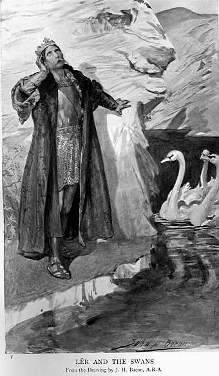
This illustration is from a 1905 book of Irish legends, Celtic Myth and Legend, by Charles Squire.

By Joan Slowey

People sometimes ask what the difference between prose and poetry is. Certainly the lines between these two forms have blurred in modern times, but generally a reader expects prose to have literal significance and poetry to have an emotional component. It would be good to keep this distinction in mind as you read Joan Slowey’s The Red Petticoat.

Joan Slowey’s poetry is personal and yet it has the kind of emotional resonance that echos in the ear and the heart of the reader. Ms. Slowey draws upon her experience. The tone of her work tends to be reflective as she looks back over a lifetime of joy, love, and loss. She uses language that has significance for her, that draws upon her Irish roots. Gaelic words pepper her writing, as do characters from Irish lore. At one point she writes an entire haiku in Gaelic. This is her heart and her psyche speaking, of her tradition and to her tradition. All of it works.

Ms. Slowey covers a variety of subjects. In each case there is evidence of a mature intelligence and a deep empathy. Ms. Slowey has witnessed the full cycle of life and is coming to terms with her place in that cycle. In Minus One, for example, she mourns the passing of her “own particular Adam.” Her “magic circle” has been broken and she wonders

insert-slowey

Two of my favorite poems draw upon her insight as a sentient observer.  One haiku, for example, notes the slime of a snail on her patio and ends with the line, “Well, snails must live too”.   Another, more thought-provoking piece contemplates a creature even more despised than the snail: a flasher.  In this poem, entitled, The Flasher, she lends complexity to a subject most of us dismiss out of hand.  What is the dark secret behind such a low act?  She wonders, as the poem draws to an end,

‘Did he shake with wicked glee?” or did he “Turn away to hide?”

The Red Petticoat is a slim volume. Its brevity invites a leisurely read, and perhaps a re-read.  If you indulge in this temptation you’re bound to find a gem, one poem that resonates with you as so many in this collection did with me.

I highly recommend Joan Slowey’s The Red Petticoat.


A. G. Moore 9/2016


War of 1812: Highlighting Native Nations

Tecumseh 2 site The story of_Isaac_Brock,_hero,_defender_and_saviour_of_upper_Canada,_1812_(1908)_(14763177825)
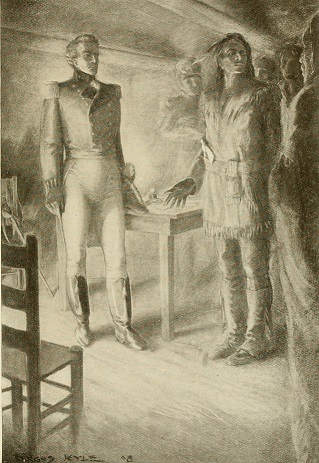
Tecumseh meets General Isaac Brock. The picture is from The Story of Isaac Brock By Walter R. Nursery

By Zig Misiak

The Star-Spangled Banner is the national anthem of the United States. It was written during the War of 1812, a war I learned about in grade school. I was taught then that the US was involved in a heroic (though ironic) Battle of New Orleans, that the US capital was burned, that Dolly Madison was brave and that the English impressed American sailors from American ships. Zig Misiak’s War of 1812: Highlighting Native Nations doesn’t mention any of these events. He describes a different war. Mr. Misiak is Canadian, and the Canadian experience was distinct from the one I learned about. Both the narrative I learned as a child and Mr. Misiak’s book are accurate, and yet so dissimilar. That’s the most interesting lesson I took from this book: a reminder that information is dependent on perspective.

War of 1812: Highlighting Native Nations is a beautiful book. It is filled with high-quality color photos that constitute a virtual tour through history, Canadian history, and the flip side of US history. Although this book was written for students, I found it engaging and enlightening. I read it in two stages. The first was a cursory review of the pictures and captions. It’s hard to resist these and so I just enjoyed myself. Then I went back to read in detail Mr. Misiak’s description of events.

This is when the lesson on perspective truly hit home. For example, Mr. Misiak speaks about the United States’ “perceived violations of American sovereignty”. Certainly England thought it had a right to institute a blockade and interfere with ships in international waters (that is, stop and board neutral vessels). It would not be the first or last nation to do this. But the fact that it was done and that a US ship was fired upon, is more than a perception. Mr. Misiak describes the United States’ ambition, and aggression, in seeking to absorb Canada. That is a fact, one that was glossed over in the history I was taught. And generally omitted in my history classes was the role of indigenous Americans and their alliance with Britain in the hope of securing an independent nation west of the Mississippi.

Indigenous Americans, Canadians, and the British fought side by side during the war. The British shared with their indigenous allies the desire to stop American expansion by creating an indigenous buffer state on the US frontier. Many Canadians died defending their homeland, as did many indigenous Americans, including the legendary Tecumseh.

The war ended with the US and Britain each declaring victory. The British agreed to respect US naval neutrality and the US abandoned its ambition to take over Canada. Besides the loss of life and devastation of property, the losers in the war were indigenous Americans. With the signing of the peace treaty, US expansion beyond the Mississippi was insured and the slow, unrelenting erosion of indigenous sovereignty proceeded.

Mr. Misiak has a gentle voice, which is consistent with his respect for people of the First Nations (a term used to describe the indigenous people of Canada). It is obvious that Mr. Misiak has cultivated a relationship with representatives of the First Nations and that he wishes to share their legacy and struggle for Constitutional rights. His book, War of 1812: Highlighting Native Nations, would be a worthy addition to any library, especially if young readers have access to that library.


A. G. Moore, September 2016