A Burial

swamp website 2018 children fixed2
Swamp: an illustration from my upcoming memoir, Arrows Axes and Scythes

By A. G. Moore

This selection is adapted from my upcoming memoir, Arrows Axes and Scythes.

Burial

The move from Krumer’s to Lockwood’s necessitated many adjustments, some positive and some less so. The increased privacy and space were balanced by a cessation of food deliveries. The problem of decreased food supply was exacerbated by an increase in the number of mouths to feed: We began to accumulate pets. Eventually, the number grew to nine. Our pet/food imbalance became a crisis as the animals starved.

I can state with certainty that my mother asked for none of the animals. She didn’t particularly enjoy having pets, but was a compassionate person. Once a pet had been remitted to her custody, she cared for it. The animals sensed this, and they loved her.

Our pets were a hodgepodge of pedigree and mutt. Some were strays and some were delivered to our door in a misguided attempt to give the pets a home. One of these charges was contributed by my father. He found a huge animal, a St. Bernard/Great Dane mix, rummaging in the garbage behind a restaurant. This “rescued” animal, Boots, became a beloved member of the family.

Another dog was brought to the home by my mother’s brother, Jimmy. Uncle Jimmy was important to the family because he owned three dry cleaning stores in Brooklyn. He regularly gave us abandoned clothes, in excellent condition. These were the core of our school wardrobe. Uncle Jimmy’s Chihuahua, Chico, was no longer welcome in his home. That’s how we got Chico.

With nine dogs in the home, and no regular food supply, my mother tried to manage. Potatoes, delivered by my uncles, were cooked and mashed for human consumption. Peels were for the dogs.

Because hunger was their perpetual companion, the dogs took measures. They foraged in neighbors’ trash. Complaints poured in, but my mother couldn’t control the animals and she couldn’t feed them. So the neighbors, or at least one of them, took their own measures. They poisoned the dogs.

Dogs began to turn up dead. They came home to die. We discovered them in various stages of decay. It was Clinton’s job to bury the deceased, but since this was a family tragedy, everybody pitched in.

With the earth frozen, burial was a particular challenge. Clinton’s solution? A bog, a quicksand pool, he found in the forest. In the picture below, the scene of a burial is depicted, as I recall it. This memory is clear.

We dragged our dog, Hortense, up to the bog. Clinton threw her, as respectfully as he could, onto the mud and we waited for her to disappear. In a very little while the surface was smooth again and Hortense was no more.
Why Are You a Writer?

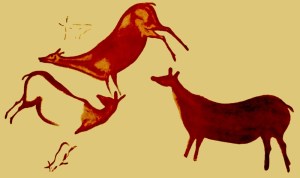
cave art La_Pasiega-Galeria_A-Ciervas_(panel_22)
Cave art from La Pasiega, in Cantabria, Spain; Author: Hugo Obermaier, 1913. This work is in the public domain.


The human effort to leave a record may be seen in cave art dating back 40,000 years.  What prompted these impulses?  Were early humans teaching a lesson?  Leaving a message?  Were they expressing devotion to a deity or satisfying an inchoate desire for self-fulfillment?  Unknowable as the answers to these questions are, so too, for many of us, is the answer to the question, “Why are you a writer?”

Writing is certainly not the most dependable way to earn money.  And it is a career that carries with it the risk of severe, personal criticism.  So, why write?

I have been writing since I was a child.  For me, writing is a way to communicate.  There are other paths to communication–music, art and dance, for example.  Sadly these avenues are not open to me.  Though I express myself with joy through many art forms, I don’t communicate well through them.  They remain my private pleasures.  Words, however, are malleable in my hands.  I mold them, sometimes nimbly, until they convey my intentions in a way that others can understand.  That’s communication.  That’s why I write.

Was I born a writer?  There’s a school of thought that holds some people are born artists and some are not.  I’ve never subscribed to this view.  Give children crayons and they color.  Read nursery rhymes to them and they respond to the cadence of words.  Creativity and art, I believe, are intrinsic to human nature.  Talents vary, as do life influences and opportunity.  The role each of these played in my choice to write–that is impossible to sort out.

I’m a writer.  I’m comfortable in the role and believe I understand the reasons for my choice.

Why are you a writer?


An Invitation To Write, For ‘Non-Writers’

pen and paper
Try to see the blank page as an opportunity and not a challenge.

By A. G. Moore

You’re probably reading this essay because you want to improve your writing skills. That is the first and most important step on the path to good writing. The next step is easier.  Pick up your instrument of choice–a pen, a pencil, a keyboard–and start writing.

Writing is like speaking.  At first, when you begin–whether it’s a foreign language or your native language in the early years of life–speaking requires great effort. You struggle for the correct phrase. You stumble and make mistakes.  After a while, as you practice and use language on a daily basis, your speech becomes smoother. You think less about how you say something and more about what you want to say.  This is fluency.

Fluency is the goal in writing and is achieved in exactly the same way that it is accomplished in speech: practice.  The more frequently you write, the more fluent your writing becomes.  Once fluency is achieved, certain techniques and rules will help to make the writing more effective. These rules and techniques are easily mastered, but they won’t work unless you have something to use them on.  So write–anything.  Write what you’d like to say.  Worry about correctness later.

Organization, grammar, style–these will come with time. Think of the pieces you write as blocks of clay.  Each time you start out there is no shape, no form to the clay.  As you begin to mold you have an idea of what you would like to see at the end of your sculpting.  After the first cuts, the lump of clay won’t look like anything.  After a while, as you shape a crude form, you can go back with your chisel and refine your art.

That’s exactly what happens in most writing.

Of course, there are exceptions. There are brilliant masters who have a touch of genius.  Words pour from them as water does from a fountain. Most of us don’t have that gift. Most of us will settle for communicating effectively.  If that is your goal, then form an idea, sit in front of a blank page and begin to express your idea.  Once you have words on a page, once you have the rough clay crudely formed, you can use basic techniques to fashion a finished product.  Logic, grammar, style–these are just carefully targeted cuts in the clay.  They can be added and adjusted as the piece takes shape.

The more often you engage in the process of writing, the more fluent you will become. If you doubt this, think about the way you learned to speak. You’ll realize that the separation between the spoken word and the written word is merely a matter of perspective and familiarity. Both of these are in your control and really present no barrier at all.