
The desire to memorialize one’s life, to put everything down in writing, tends to grow with age. But many people do not feel up to the task of creating a book. Reflecting is designed to enable these people to satisfy their very human impulse to remember, and to be remembered.
The inspiration for the project began with the misfortune of one woman. The woman had suffered a stroke; it seemed her ambition to put together a book that chronicled her life would never be realized. But a way was found to see this ambition achieved. Miscellaneous essays, poems and photos were collected. These were organized into an anthology, which was published.
The simple act of publishing cheered the author as no one and nothing had managed to do up to that point. The lesson learned was this: ministering to the body may be a doctor’s work but ministering to the heart may require attention of a different sort.
And so Reflecting was born. It grew out of the conviction that with guidance, just about anyone can write a book, and writing the book can be richly rewarding. The challenge was to design a template that would gently lead the novice author through different stages of recollection and recording. This template would have to be accessible, so that even individuals with limited function could follow its many small steps on to crafting a cohesive document.
On its most basic level, the Reflecting template requires an individual to provide simple answers to simple questions. In the aggregate these answers and questions will offer insight into the author’s life. Photos, sprinkled throughout, will complement verbal responses.
At a more advance level, completion of Reflecting provides opportunity for explanation, exploration and illumination of an individual’s life. And, at its most ambitious, Reflecting will be the foundation for a comprehensive, traditional memoir.
One of the most important goals of Reflecting is to encourage communication. Remembering a life need not be a solitary exercise. Family and friends can be drawn into stimulating conversations about events long forgotten. Moments that might have been spent in awkward silence can now be invested in completing the book. When it’s completed, the book will be a gift to all who participated in its creation, and to those who did not but are heir to the legacy described in its pages.
Category: Health
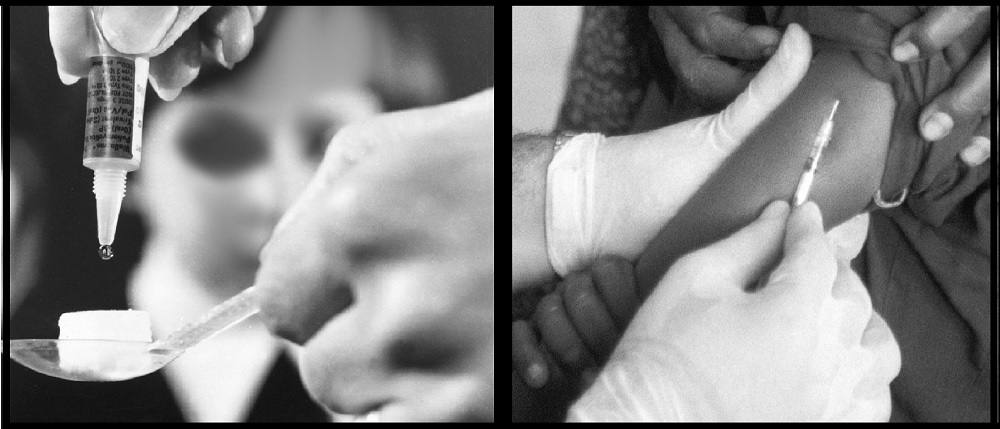
Salk or Sabin Polio Vaccine?
By A. G. Moore
The following is adapted from the Rhythm Prism publication Jonas Salk. Although Jonas Salk was written with young readers in mind, there’s a lot in the book that may be informative to more mature readers. For example, until I researched this book, I didn’t understand why the Salk or Sabin vaccine would be used in specific circumstances. Now I do understand: each vaccine has different risks and benefits
Adaptation from Jonas Salk:
Both the oral and injectable forms of the polio vaccine have been in use for more than fifty years. This has given the global community enough experience to understand risks and benefits of each.
Since the Sabin vaccine uses a live, though weakened virus, there is a slight chance that vaccination will actually give someone polio. This has happened in a small number of cases. Because of this risk, the Sabin vaccine was discontinued in the US and only the Salk is administered.
However, there is also a risk from the Salk vaccine. With the Salk vaccine, a very weak immunity is produced in the gut. If someone who has been vaccinated is exposed to wild polio, there is the possibility that the wild virus will multiply in the gut. Though the vaccinated individual may not become ill with polio, they can shed virus in their excrement. This shed virus then becomes a source of contagion for others in the community.
Because of the way the Sabin and Salk vaccines work, they are generally used in different places. If there is good vaccine coverage in an area, and most people have immunity to polio, then the Salk vaccine is used. This is generally considered safer because the vaccine cannot make the individual sick, and virus shed in excrement will not be dangerous to others who have been vaccinated.
On the other hand, if a polio vaccination campaign is conducted in an area where there are many unvaccinated people, the oral vaccine might be considered preferable. With the oral vaccine there is no risk of shed virus infecting unvaccinated people. However, the risk remains that in a small number of cases, someone may actually contract polio from the vaccine itself. Not only can these people become ill, but they can infect others who haven’t been vaccinated.
One more consideration in the selection of vaccines is cost. Giving the Salk vaccine is about five times more expensive than giving the Sabin vaccine. In areas where resources are scarce, this is an important factor.
Polonium in Cigarettes

Last week I was researching material for a new book, Marie Curie. Madame Curie, I learned, was like many very successful people: absolutely determined and stubbornly undeterrable. Although she was not allowed to study because she was a woman and she was Polish, she earned several advanced degrees. She could not find a laboratory, did not have money for heat or food, and yet she performed groundbreaking experiments.
Marie Curie won two Nobel prizes, the first person ever to do so in two categories. She was the first female professor at the Sorbonne and the first woman to win a Nobel prize. She was also the first person to operate a mobile x-ray unite in a war zone.
So what does all of this have to do with polonium in cigarettes? Marie Curie discovered polonium and radium. She knew they were radioactive; she knew they could burn skin, treat cancers and kill bacteria. But somehow she never acknowledged that her beloved radioactive elements could be harmful to her health.
Marie Curie, and her daughter Irene, died of cancer.
Millions of people smoke. Most of these people understand in some vague way that they shouldn’t smoke, but the threat they perceive seems distant. Perhaps if they knew clearly what some scientists and all cigarette manufacturers know, then these smokers might grasp the risk that cigarettes pose to them.
Cigarette smoke contains polonium, the same polonium that Marie Curie discovered and named more than a hundred years ago. The amount of polonium in cigarettes varies according to the region where tobacco is grown. US cigarettes definitely contain detectable amounts.
So, when a smoker takes a good puff and inhales, along with all the other things in the smoke that might harm, there is a dose of polonium–radioactive, cancer-causing polonium. A good long puff on a cigarette delivers that polonium directly to lung tissue.
I think that’s something people ought to know.
Rhythm Prism’s compact book on Marie Curie, polonium, radium and radioactivity:

Available in print,
on Kindle
and through other eBook vendors
 Rhythm Prism Publishing
