War of 1812: Highlighting Native Nations

Tecumseh 2 site The story of_Isaac_Brock,_hero,_defender_and_saviour_of_upper_Canada,_1812_(1908)_(14763177825)
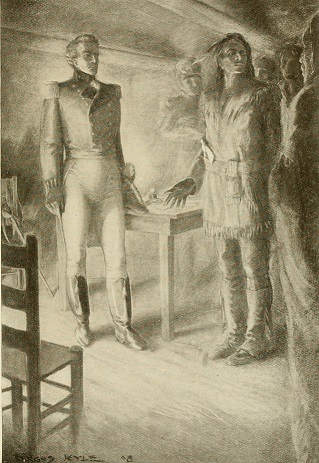
Tecumseh meets General Isaac Brock. The picture is from The Story of Isaac Brock By Walter R. Nursery

By Zig Misiak

The Star-Spangled Banner is the national anthem of the United States. It was written during the War of 1812, a war I learned about in grade school. I was taught then that the US was involved in a heroic (though ironic) Battle of New Orleans, that the US capital was burned, that Dolly Madison was brave and that the English impressed American sailors from American ships. Zig Misiak’s War of 1812: Highlighting Native Nations doesn’t mention any of these events. He describes a different war. Mr. Misiak is Canadian, and the Canadian experience was distinct from the one I learned about. Both the narrative I learned as a child and Mr. Misiak’s book are accurate, and yet so dissimilar. That’s the most interesting lesson I took from this book: a reminder that information is dependent on perspective.

War of 1812: Highlighting Native Nations is a beautiful book. It is filled with high-quality color photos that constitute a virtual tour through history, Canadian history, and the flip side of US history. Although this book was written for students, I found it engaging and enlightening. I read it in two stages. The first was a cursory review of the pictures and captions. It’s hard to resist these and so I just enjoyed myself. Then I went back to read in detail Mr. Misiak’s description of events.

This is when the lesson on perspective truly hit home. For example, Mr. Misiak speaks about the United States’ “perceived violations of American sovereignty”. Certainly England thought it had a right to institute a blockade and interfere with ships in international waters (that is, stop and board neutral vessels). It would not be the first or last nation to do this. But the fact that it was done and that a US ship was fired upon, is more than a perception. Mr. Misiak describes the United States’ ambition, and aggression, in seeking to absorb Canada. That is a fact, one that was glossed over in the history I was taught. And generally omitted in my history classes was the role of indigenous Americans and their alliance with Britain in the hope of securing an independent nation west of the Mississippi.

Indigenous Americans, Canadians, and the British fought side by side during the war. The British shared with their indigenous allies the desire to stop American expansion by creating an indigenous buffer state on the US frontier. Many Canadians died defending their homeland, as did many indigenous Americans, including the legendary Tecumseh.

The war ended with the US and Britain each declaring victory. The British agreed to respect US naval neutrality and the US abandoned its ambition to take over Canada. Besides the loss of life and devastation of property, the losers in the war were indigenous Americans. With the signing of the peace treaty, US expansion beyond the Mississippi was insured and the slow, unrelenting erosion of indigenous sovereignty proceeded.

Mr. Misiak has a gentle voice, which is consistent with his respect for people of the First Nations (a term used to describe the indigenous people of Canada). It is obvious that Mr. Misiak has cultivated a relationship with representatives of the First Nations and that he wishes to share their legacy and struggle for Constitutional rights. His book, War of 1812: Highlighting Native Nations, would be a worthy addition to any library, especially if young readers have access to that library.


A. G. Moore, September 2016

Street Whys: Book Review


kingston Beers_Atlas_Page053-054
This is a picture of Kingston New York, c. 1875, from the Beers Atlas of Ulster County. Copyright expired

E. M. Ford

Street Whys was given to me by a friend who knew I had grown up in a Hudson Valley community. Kingston, where all the streets identified in the book are located, is located along the Hudson River and is one of the oldest cities in New York State. This book represents a lifetime of research by E. M. Ford, a local historian. The breadth of Mr. Ford’s knowledge is impressive. While the intended audience may seem to be limited to those who live in or near Kingston, this is by no means the case. The book is a study in the development of an American city. By tracing the history of every highway and byway, Mr. Ford delves into the lives and biographies of people responsible for Kingston’s growth from its earliest days.

One of the more delightful aspects of the book is its attention to detail. Mr. Ford is not careless. He displays a historian’s temperament as he fastidiously acknowledges uncertainty about the provenance of certain street names. Of course, many streets are named after significant townspeople. I did amuse myself by looking for the names of my ancestors and found among the many who were listed some who were distant, long-deceased relatives. These family names were common in the Northeast and throughout the United States during the Colonial era.

E.M. Ford deserves great credit for creating such a responsible book of local history. Though it is not likely to attract a wide audience, the book nonetheless is a valuable contribution to the historiography of the early settlement of the U.S. This is not the kind of book that a reader ever “finishes”. Rather, it will become an accustomed presence on the shelf, one that brings pleasure each time it is perused and the wealth of information contained within is rediscovered.

If you like history and are curious about the foundation of the U.S., read this very interesting book.


A. G. Moore

Prologue to Arrows Axes and Scythes


witness2
Witness: an illustration from Arrow Axes and Scythes

Below is the Prologue to my upcoming illustrated memoir, Arrow Axes and Scythes.  While the book recalls a time long passed, the influence of those years lasted a lifetime.  The Prologue explains the author’s attempt to convey the emotional content of memory without distorting the essential truth of events.

We are all invisible witnesses. If not for this, how many crimes would be reported?

I think we imagine that children do not see and if they see they do not understand. We reassure ourselves, as we carry on in our imperfect ways, that even if they understand they surely will forget. But the mind is not so dependably careless with its impressions. Many remain for a lifetime.

The events recorded in this book occurred more than fifty years ago, when I was a child. Some memories are lost to me, yet many come back. Are these accurate? Perhaps. Perhaps not. Ideas are not preserved in amber. They are subject to the whims of experience and bias.

My childhood was a time of secrets. Much that is revealed here was never meant to be public. But what I could not say then, will now be told.

At the end of the book one of the personalities, my father, offers testimony for himself. A letter exists in which he describes motivation for his actions. Readers may weigh this evidence and decide for themselves whether or not the document supports my value as a witness.


An excerpt is offered in another blog on this site: A Burial