Marie Curie on Education

Theories about education don’t evolve; they erupt.  Most people understand that childhood offers an irreplaceable opportunity to influence minds for a lifetime.   Maybe that explains the furor surrounding the roll-out of the Common Core in communities across the US. While the trend toward rigid standards, uniform curriculum and increased formal instruction seems sound to some, to others it seems a travesty, a squandering of childhood’s most precious gifts:  play, imagination and exploration. Included in this camp would surely be Marie Curie, if she were alive today to express a view.

In a book she wrote about her mother, Marie Curie’s youngest daughter, Eve, described Marie’s views on education.  Eve explained that Marie dreaded sending her children into the sterile, confined atmosphere of a structured classroom.  Marie regarded formal schooling as  “hours of attendance”.  Her philosophy was that children should be encouraged to find their talent through exploration.  It was in this way that Irene, the older daughter, discovered an early interest in mathematics; and Eve, the younger daughter, learned through experimentation that she was fascinated with music.

Essential to the daily regimen of both Curie children was vigorous physical activity.  Marie installed gym equipment at home and took the girls on camping trips. Together the family trekked through the countryside on extensive biking trips.  “Formal” instruction was put off as long as possible.  In its place, Marie devised a scheme with her  colleagues at the Sorbonne.

The girls, and several other children, would be exposed to the finest minds, in a congenial atmosphere.  Each day the children would spend hours with a professor from a specific discipline.  The weeks would be passed in this way, with a casual rotation between specialties and a cheerful approach toward learning.

Eventually Marie’s daughters were obliged to go to formal classes, but not until this was absolutely necessary.  Irene eventually earned a Doctor of Science degree and Eve earned two bachelor degrees, one in philosophy and one in music.

Irene went on to win a Nobel Prize in 1935 and later continued to do groundbreaking research in nuclear physics.  Eve was for a time a concert pianist. She was also a journalist, diplomat and humanitarian.

Irene died in 1956, Eve in 2007. I would be hard to imagine two more accomplished women.  Whether their mother’s approach to education enabled a lifetime of accomplishment, it would be hard to say.  But their lives and achievements certainly make a good argument for those who believe that a a rigid curriculum may not be the path to a great mind.
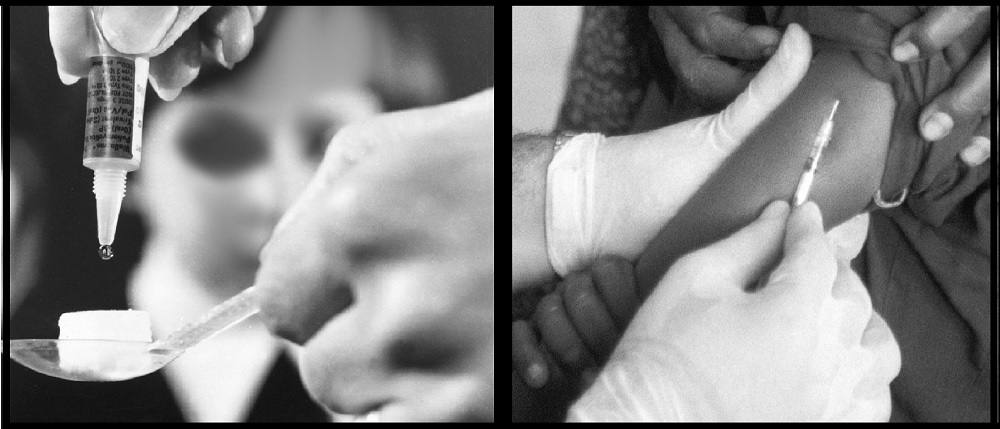
Salk or Sabin Polio Vaccine?


salk sabin vaccines picture

By A. G. Moore

The following is adapted from the Rhythm Prism publication Jonas Salk.  Although Jonas Salk was written with young readers in mind, there’s a lot in the book that may be informative to more mature readers.  For example, until I researched this book, I didn’t understand why the Salk or Sabin vaccine would be used in specific circumstances. Now I do understand: each vaccine has different risks and benefits

Adaptation from Jonas Salk:

Both the oral and injectable forms of the polio vaccine have been in use for more than fifty years. This has given the global community enough experience to understand risks and benefits of each.

Since the Sabin vaccine uses a live, though weakened virus, there is a slight chance that vaccination will actually give someone polio. This has happened in a small number of cases. Because of this risk, the Sabin vaccine was discontinued in the US and only the Salk is administered.

However, there is also a risk from the Salk vaccine. With the Salk vaccine, a very weak immunity is produced in the gut. If someone who has been vaccinated is exposed to wild polio, there is the possibility that the wild virus will multiply in the gut. Though the vaccinated individual may not become ill with polio, they can shed virus in their excrement. This shed virus then becomes a source of contagion for others in the community.

Because of the way the Sabin and Salk vaccines work, they are generally used in different places. If there is good vaccine coverage in an area, and most people have immunity to polio, then the Salk vaccine is used. This is generally considered safer because the vaccine cannot make the individual sick, and virus shed in excrement will not be dangerous to others who have been vaccinated.

On the other hand, if a polio vaccination campaign is conducted in an area where there are many unvaccinated people, the oral vaccine might be considered preferable. With the oral vaccine there is no risk of shed virus infecting unvaccinated people.  However, the risk remains that in a small number of cases, someone may actually contract polio from the vaccine itself. Not only can these people become ill, but they can infect others who haven’t been vaccinated.

One more consideration in the selection of vaccines is cost. Giving the Salk vaccine is about five times more expensive than giving the Sabin vaccine. In areas where resources are scarce, this is an important factor.

Polonium in Cigarettes

cigarette smoke smash

Last week I was researching material for a new book, Marie Curie.  Madame Curie, I learned, was like many very successful people: absolutely determined and stubbornly undeterrable.  Although she was not allowed to study because she was a woman and she was Polish,  she earned several advanced degrees.  She could not find a laboratory, did not have money for heat or food, and yet she performed groundbreaking experiments.

Marie Curie won two Nobel prizes, the first person ever to do so in two categories.  She was the first female professor at the Sorbonne and the first woman to win a Nobel prize.  She was also the first person to operate a mobile x-ray unite in a war zone.

So what does all of this have to do with polonium in cigarettes? Marie Curie discovered polonium and radium.  She knew they were radioactive; she knew they could burn skin, treat cancers and kill bacteria.  But somehow she never acknowledged that her beloved radioactive elements could be harmful to her health.

Marie Curie, and her daughter Irene, died of cancer.

Millions of people smoke.  Most of these people understand in some vague way that they shouldn’t smoke, but the threat they perceive seems distant.  Perhaps if they knew clearly what some scientists and all cigarette manufacturers know, then these smokers might grasp the risk that cigarettes pose to them.

Cigarette smoke contains polonium, the same polonium that Marie Curie discovered and named more than a hundred years ago. The amount of polonium in cigarettes varies according to the region where tobacco is grown.  US cigarettes definitely contain detectable amounts.

So, when a smoker takes a good puff and inhales, along with all the other things in the smoke that might harm, there is a dose of polonium–radioactive, cancer-causing polonium.  A good long puff on a cigarette delivers that polonium directly to lung tissue.

I think that’s something people ought to know.


Rhythm Prism’s compact book on Marie Curie, polonium, radium and radioactivity:

marie and atom 5 cover smash site

Available in print,

on Kindle

iBook

and through other eBook vendors