Maxwell Corydon Wheat, Jr.

max-salt-marsh-cover-site
This thirty-page book will be sold at cost in the United States. 

 From the Introduction

I met Max when he already had achieved a certain notoriety. It was incongruous to me that the peaceful, soft-spoken man I beheld could be the cause of controversy. But it was exactly his peaceful nature that gave rise to offense.

Maxwell Corydon Wheat Jr. was Poet Laureate of Nassau Country, New York. This is the sort of honor that usually attracts little attention, outside the poetry community. But that’s not how things worked in Nassau County.

The County Legislature decided Max was not worthy to be Poet Laureate, because he had written a book about peace in a time of war.

Max’s nomination was rejected. This slight suggested that, not only did the bureaucrats know little about poetry, but they also had a poor understanding of poets.

The poetry community dismissed the dismissal. They crowned their laureate, who had earned his title through acclaim and accomplishment. Hence, Max, a quiet, slight figure with a steady gaze, became the center of controversy.

Max was my teacher. He led a group of Taproot writers. That’s what he called all of us, no matter our skill level: everyone was a poet and everyone was a writer. Over time, this proved true, to varying degrees, for those who persevered under his leadership.

Each voice in the group was given a moment in the spotlight, and each was respected. The only exceptions to this rule were when voices were raised in hatred or anger. Neither of these sentiments survived long in a group led by a man of peace.

Max held his sessions in the fall and spring. When time came to sign up for a session, I’d go down the first day I was allowed. His class was so popular that it might be oversubscribed and I’d be shut out. However, there was little danger of that. Though the door might be officially closed to late entrants, I can’t recall a time when Max turned someone away.

There was, for example, the day a distracted woman wandered into our room. None of us knew her. She was looking for another event and accidentally stumbled upon our class.

A chair was empty, so she sat down. She even joined in the discussion, as I recall. Max didn’t suggest that she was unwelcome, or in the wrong place. When she left, he didn’t chuckle derisively, as some might have been tempted to do. We took our lead from his behavior, as we always did.

That episode captured Max’s strength, and his character. He filled the room with grace, the grace of kindness and generosity. And he had the strength to enforce this environment, by example, and by instruction, when necessary.

I learned to write under Max’s tutelage. Before I entered his class, there was so much I didn’t know. He never let on, as I floundered in those early days. My confidence grew and his lessons took root. It is rare that I write a piece now, and Max’s hand is not on it.

There was a time when I had little patience for poetry. It seemed a self-indulgent art with little objective value. I still don’t write poetry, despite Max’s best efforts, but my ears, my eyes and my heart are open to it.

For the last few years I’ve been writing nonstop–books, blogs, reviews. There is a sense of time running out, but there’s more than that. Max helped me to find my voice and to develop the belief that I can do it, that my effort is valid.

Thank you, Max, for everything. You were an artist, a peacemaker and a teacher. You are missed.

Moments in Life: Book Review

floating-leaf-public-domain

By Eileen Troemel

Usually, when I prepare to read a book of poems, there’s a certain amount of apprehension, unless the poet is known to me. While I enjoy the immediacy of emotion that poetry offers, some authors who use this form do not exercise discipline, and a good poem requires some of that. It is economy of expression that often gives a poem its edge.  And so I began Eileen Troemel’s Moments in Life guardedly–although, to be sure her evocative cover was reassuring.

Readers who also harbor apprehensions about an unfamiliar poet’s work may venture into Ms. Troemel’s aesthetic universe without reservation. There is revealed in her work a refined sensibility, a presence informed by both insight and compassion. Moments in Life is the sort of book one might keep in the bed stand, to sooth and settle the spirit before submitting to the suggestible realm of sleep.

Last night, one poem struck me with special force. Today, I scrolled through Moments in Life so I could find that poem and use it as an example in this review. However, my morning eyes did not see what my mind clearly understood the night before. Other gems caught my attention. This is one of the charms of the collection: it accommodates the mood and the requirements of the moment. A nostalgic inclination, for example, might find resonance in a poem called My Mother’s Kitchen. In more reflective moments, Life’s Cycles might might respond to the inclination to ponder.

One poem that struck me on every reading was Adventures of a Wild Leaf. This poem is brilliant with imagery and takes the reader through stages of anticipation, loss, and then hope.

This volume is not Ms. Troemel’s first. With the skill on display here, that is not surprising. I expect to hear more from this poet in the future. She evidently has a deep well from which to draw.

The Red Petticoat: A Collection of Poems

chidren-of-lir-ler_swans_millar-2
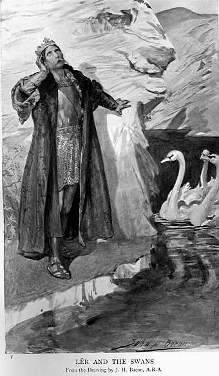
This illustration is from a 1905 book of Irish legends, Celtic Myth and Legend, by Charles Squire.

By Joan Slowey

People sometimes ask what the difference between prose and poetry is. Certainly the lines between these two forms have blurred in modern times, but generally a reader expects prose to have literal significance and poetry to have an emotional component. It would be good to keep this distinction in mind as you read Joan Slowey’s The Red Petticoat.

Joan Slowey’s poetry is personal and yet it has the kind of emotional resonance that echos in the ear and the heart of the reader. Ms. Slowey draws upon her experience. The tone of her work tends to be reflective as she looks back over a lifetime of joy, love, and loss. She uses language that has significance for her, that draws upon her Irish roots. Gaelic words pepper her writing, as do characters from Irish lore. At one point she writes an entire haiku in Gaelic. This is her heart and her psyche speaking, of her tradition and to her tradition. All of it works.

Ms. Slowey covers a variety of subjects. In each case there is evidence of a mature intelligence and a deep empathy. Ms. Slowey has witnessed the full cycle of life and is coming to terms with her place in that cycle. In Minus One, for example, she mourns the passing of her “own particular Adam.” Her “magic circle” has been broken and she wonders

insert-slowey

Two of my favorite poems draw upon her insight as a sentient observer.  One haiku, for example, notes the slime of a snail on her patio and ends with the line, “Well, snails must live too”.   Another, more thought-provoking piece contemplates a creature even more despised than the snail: a flasher.  In this poem, entitled, The Flasher, she lends complexity to a subject most of us dismiss out of hand.  What is the dark secret behind such a low act?  She wonders, as the poem draws to an end,

‘Did he shake with wicked glee?” or did he “Turn away to hide?”

The Red Petticoat is a slim volume. Its brevity invites a leisurely read, and perhaps a re-read.  If you indulge in this temptation you’re bound to find a gem, one poem that resonates with you as so many in this collection did with me.

I highly recommend Joan Slowey’s The Red Petticoat.


A. G. Moore 9/2016