A Look Back at Vaccines

Mary Wortley Montague public domain

As various strains of the flu claim lives this week, I take a look back at a time before vaccines, when people tried to protect themselves from deadly epidemics with desperate measures.  The passage below is an excerpt from my book, Jonas Salk: The Battle Against Polio.  The passage refers not to polio, but to smallpox.  The idea of induced immunity took hold among some.  Variolation–deliberately infecting the healthy with smallpox–was one early practice.  A diplomat’s wife, Lady Mary Wortley, introduced the practice to Europe.

Lady Wortley’s practice was not that far removed from the development of the polio vaccine.  In the twentieth century, two varieties became available.  One, the Salk vaccine, introduced a killed virus into a healthy person.  The other, the Sabin vaccine, introduced a weakened, live virus.  Each of these vaccines carried risks, though the risks were not as great as they had been with variolation.

  What follows is a brief description of Lady Mary Wortley’s experience with variolation.

In 1716 Lady Mary Wortley Montagu accompanied her husband, Edward, to Istanbul, where he became Ambassador to the Ottoman Empire. In Istanbul Lady learned about variolation. Lady Mary’s brother had died from smallpox and she had survived the disease. Although little was understood about smallpox, one thing was certain: once people survived the disease, they would never catch it again. This was the wisdom behind variolation.

The Ottomans dealt with smallpox by taking a small bit of dried material from the scab of someone who was infected with a mild case of the disease. The dried material would be blown into the nostrils of a healthy person. The idea was to make the healthy person come down with a mild case of smallpox and gain immunity from the disease for life. This was the Ottoman version of variolation.

When Lady Mary brought the practice to Europe, it was a little different. In Europe, material would be scraped from a smallpox scab on someone who was actively suffering from the disease. This material would then be scraped into the skin of a healthy person. That person, it was hoped, would come down with a mild form of smallpox, survive, and then have immunity for life.

Variolation was widely used, especially among the powerful. Though many did not trust the procedure, it was the only way to induce immunity from smallpox until Edward Jenner discovered a vaccine. Variolation was largely abandoned after Jenner’s vaccine because it was possible to come down with severe cases of smallpox as a result of the procedure. There were deaths from variolation.

A. G. Moore

February 5, 2018

Susan: Convict’s daughter, soldier’s wife, nobody’s fool, By Stella Budrikis

susan book review aldershoot 1866.jpg
Garrison town, Aldershot, England, where David Whybrew was stationed in 1871. 

Book Review by A. G. Moore

Stella Budrikis’ excellent biography, Susan, takes readers on a journey through the hardscrabble existence of Australia’s early European settlers. The eponymous Susan is Susan Mason, the author’s great–great grandmother.  The characters in this book are real people who struggle in the harshest of circumstances.  Fortune, will and physical endurance allow some to reach maturity and raise families.  Survival is a lottery in which perseverance and serendipity play equal roles.

Nature granted Susan the ability to bear numerous children.  Fortune took many of these from her.  This was a common occurrence at that time, but more likely to befall those who were crowded into the hull of a ship or crammed into a fetid slum where immigrants congregated.

Susan eventually migrated to England, where she settled with her husband, David Whybrew, a soldier in the British army. David’s income barely supported the growing Whybrew family. Throughout her sojourn in Australia and England, Susan had repeated contact with the police. Indeed much of the record cited in this book is derived from official court records.   Budrikis does not shrink from the less attractive aspects of Susan’s life. It is the author’s unflinching treatment of her subject that renders her narrative credible.

One of the several Whybrew children who did reach maturity, Eliza, was destined to be the author’s great grandmother. Eliza’s life followed a very different path from Susan’s. This may have been partly due to temperament and partly to the influence of her husband, William Beales.  Beales and his family were active in the Salvation Army.  This involvement likely offered Eliza the sort of stable guidance that had not been available to Susan.

In the “Afterword” to Susan, Budrikis wonders if she’s done right by her forbear in telling this story  without attempting to conceal blemishes. Budrikis writes, “I hope that by telling her story I have given her, and other women like her, a recognition that they were denied in their lifetime”.  Indeed she has. Susan Mason made choices that put her afoul of the law and forged for her a chaotic path through life.  But those choices also helped her to survive.  Susan Mason and thousands of others had only their wits and their determination to help them prevail over daunting odds.  They survived.  When life is stripped to its barest essentials, that becomes the ultimate test of character.

Stella Budrikis has written a book about more than family legacy.  It is about a time and place in history, about pioneers who were essential to the foundation of Australia.  The book is informative and entertaining.  I highly recommend it.


Ms. Budrikis maintains a website that traces her family history.  It is a fascinating read.


Art in China

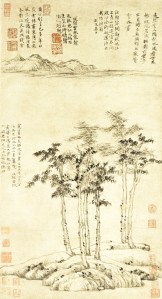
Six Gentlemen, by Ni Zan (1301-1374)

Ni Zan - Six Gentlemen

China is much in the news.  It seems that many in the West cannot decide whether China is a worthy ally or a wily competitor.  The lack of clarity arises not so much from linguistic barriers as it does from a cultural disconnect.  We in the West, particularly in the United States, don’t know much about China.  We buy Chinese goods and many of us enjoy Chinese food.  Student exchange programs with China have increased in recent years, but familiarity with our distant Asian neighbors is limited in scope.  Any attempt to increase understanding of China is a step forward.  One path that may take us in that direction is through China’s art, particularly a style of art known as literati painting.

On this page are four landscape paintings, all of them either in literati style, or influenced by the literati.  Comparing the four paintings reveals something fascinating: this style of painting has remained essentially consistent for hundreds of years.  That is not a coincidence.  That is a reflection of a profoundly significant aspect of China’s culture.  Tradition and history are revered, preserved and emulated.

As Westerners attempt to achieve an understanding of the modern powerhouse that is China, they would do well to regard its past.  China’s traditional art offers a readily available, aesthetically beguiling opportunity to do that.

Joint Landscape by Shen Zhou (1427-1509) and Wen Zhengming (1470-1559)

shen zhou Joint Landscape rhythm MET_DP235702_CRD


Hermitage in the Mountains, by Tang Yifen (1778-1853)

Tang Fi 1856 'Hermitage in the_Mountains' rhythm,_painting_by_T'ang_I-fen


The Painting by Gao Jianfu 2, by Gao Jianfu (1879-1951)

gao jianfu 1935 rhythm

An essay in which I go into greater length about the importance of tradition in China may be found at another website I maintain, noplaceforrumors.com:

https://noplaceforrumors.wordpress.com/2017/09/19/four-masters-of-yuan-and-literati-art-tradition-in-china-from-mongol-rule-to-modern-times/